HI all
I am looking at building a lithium pack for my daughters wheelchair. She had a modifed chair for a long time (I did modifications similar to the BM chairs on her previous chair) but this chair is relatively standard. However what she does need is battery range. She also cannot charge every night because of her circumstances at the moment and the batteries being less prone to damage in this scenario is also of interest to us. However, she isn't very technical and gets confused easily and her partner is not much better.
So, I need to set up charging which she can just plug in and use. Any more detailed analysis of data and correction will have to wait until she is visiting us, which is usually every couple of months. I am concerned that the PL8 might be complex, however I don't have one yet so don't really know.
In this circumstance what would people recommend? So far I see the following options:
PL8
Use a BMS but only as a charger.
Use a BMS fully
use "Drop in" batteries with built in BMS (I know, I know, but maybe they have got better?)
Another charger I haven't thought of yet
Also, it would be of some use to have some info on state-of-charge and some indication if the cell voltages are going to drop too low, although I accept that with an adequately sized pack, this need is reduced.
Advice or information on these options would be appreciated!
Thanks!
"Simple" solution for Lithium charging
107 posts
• Page 1 of 4 • 1, 2, 3, 4
"Simple" solution for Lithium charging
 by rune » 07 Aug 2025, 18:24
- rune
- Posts: 90
- Joined: 28 Jan 2013, 11:05
- Location: West Sussex, UK
Re: "Simple" solution for Lithium charging
by Williamclark77 » 07 Aug 2025, 19:58
JKBMS. I have been using them on two chairs for five or so years. Ignore the "BMS" in its name. When configured correctly it's nothing more than an onboard smart charger. It has a good Android app that shows state of charge (only as accurate as how well you set it up) along with each individual cell voltage. It also has an optional screen that can give all of the info needed without a phone. I don't know if it has an iphone app. I don't have an iphone.
To charge, simply connect any dumb cheap power supply with a slightly higher voltage than your battery pack. Eight amp output is plenty. It can balance at two amps and doesn't overshoot the individual cell cutoff voltage. Use any polarized charge connector you like.
It's really as simple as plug in the power supply to the wall. Plug into the chair. Go away. When you see the volts static and amps at zero on the power supply it is charged and balanced.
I've built several packs for myself and others ordering the "JKBMS" from https://energiepanda.com/product/jk-act ... tery-pack/
There are a lot of knockoffs.
I have used quite a few of these connectors with good success.
https://a.co/d/h7SUMaN
I can help you with setup. Out of the box generic settings are nowhere near correct.
To charge, simply connect any dumb cheap power supply with a slightly higher voltage than your battery pack. Eight amp output is plenty. It can balance at two amps and doesn't overshoot the individual cell cutoff voltage. Use any polarized charge connector you like.
It's really as simple as plug in the power supply to the wall. Plug into the chair. Go away. When you see the volts static and amps at zero on the power supply it is charged and balanced.
I've built several packs for myself and others ordering the "JKBMS" from https://energiepanda.com/product/jk-act ... tery-pack/
There are a lot of knockoffs.
I have used quite a few of these connectors with good success.
https://a.co/d/h7SUMaN
I can help you with setup. Out of the box generic settings are nowhere near correct.
-

Williamclark77 - Posts: 1182
- Joined: 21 Mar 2013, 01:18
- Location: South Mississippi, United States
Re: "Simple" solution for Lithium charging
by emilevirus » 07 Aug 2025, 20:00
Some people here may not agree with me. I use a JK BMS with a battery meter display directly connected to the BMS. Gives you real battery percentage. Just get a 200A BMS and remove all overcurrent protection. I use Shirley's PSU to charge. No PL8. Works great so far.
- emilevirus
- Posts: 520
- Joined: 12 Aug 2020, 22:02
Re: "Simple" solution for Lithium charging
by Williamclark77 » 07 Aug 2025, 20:02
I suggest getting the screen if for no other reason than it has a button to turn the unit on and off. You'll think your unit is doa after hooking it up. Initially turning it on is a process without the screen.
-
Williamclark77 - Posts: 1182
- Joined: 21 Mar 2013, 01:18
- Location: South Mississippi, United States
Re: "Simple" solution for Lithium charging
by rune » 07 Aug 2025, 21:53
That sounds like exactly what I need!
Thanks for the recommendation, I will look into it.
Thanks for the recommendation, I will look into it.
- rune
- Posts: 90
- Joined: 28 Jan 2013, 11:05
- Location: West Sussex, UK
Re: "Simple" solution for Lithium charging
by shirley_hkg » 08 Aug 2025, 02:12

- shirley_hkg
- Posts: 4643
- Joined: 31 Dec 2010, 13:42
Re: "Simple" solution for Lithium charging
by Burgerman » 08 Aug 2025, 02:48
In her situation I would agree.
I also suggest you take a look at big 230Ah cells. Dont be tempted by the drop in lead brick replacements.
Why?
Because presuming her batts are typical 74Ah to 85Ah lead bricks (GRP 24 Lead) then the biggest drop in replacements are about the same Ah. While its true that you would get maybe 50% additional range over lead for tech reasons if you run then down fully you cant if you actually do that if you want them to last. And if you dont leave some in reserve you also run the risk of stopping suddenly and not getting back home.
So...
In the same space that the lead comes out you can fit some 230Ah (244Ah measured) EVE cells from Docan. These allow you to have around 5x the range, of the lead while still leaving the equivelent of a set of lead batteries in reserve! So can be used for a few days heavily at a time. And because they are huge, you never really run them low of need to charge frequently. That means they will likely outlive you.
And the cost of these huge capacity batteries? Less than the price of lead.
Yes in your case a JKBMS makes sense. But they are big. Finding the space to fit one is an issue. And they do need some careful configuration, not stock default values.
See here: https://www.wheelchairdriver.com/board/ ... 4&start=30
I also suggest you take a look at big 230Ah cells. Dont be tempted by the drop in lead brick replacements.
Why?
Because presuming her batts are typical 74Ah to 85Ah lead bricks (GRP 24 Lead) then the biggest drop in replacements are about the same Ah. While its true that you would get maybe 50% additional range over lead for tech reasons if you run then down fully you cant if you actually do that if you want them to last. And if you dont leave some in reserve you also run the risk of stopping suddenly and not getting back home.
So...
In the same space that the lead comes out you can fit some 230Ah (244Ah measured) EVE cells from Docan. These allow you to have around 5x the range, of the lead while still leaving the equivelent of a set of lead batteries in reserve! So can be used for a few days heavily at a time. And because they are huge, you never really run them low of need to charge frequently. That means they will likely outlive you.
And the cost of these huge capacity batteries? Less than the price of lead.
Yes in your case a JKBMS makes sense. But they are big. Finding the space to fit one is an issue. And they do need some careful configuration, not stock default values.
See here: https://www.wheelchairdriver.com/board/ ... 4&start=30
-

Burgerman - Site Admin
- Posts: 70956
- Joined: 27 May 2008, 21:24
- Location: United Kingdom
Re: "Simple" solution for Lithium charging
by rune » 08 Aug 2025, 14:51
Thanks BM.
Yes, finding somewhere to fit it is an issue. I will have to work out if I have space with the 230ah ones...
Yes, finding somewhere to fit it is an issue. I will have to work out if I have space with the 230ah ones...
- rune
- Posts: 90
- Joined: 28 Jan 2013, 11:05
- Location: West Sussex, UK
Re: "Simple" solution for Lithium charging
by Williamclark77 » 08 Aug 2025, 15:39
The 16s 2amp version I use measures 6.4 inches tall, 4 inches wide, and .8 inches thick at the thickest point. Considerably thinner along most of it. The 8s version looks to be smaller. I can't confirm that though. Never seen one in person. I wrap mine in with the tape on the front when I final assemble the cells. Overheating has not been an issue and I routinely pull 130 amps through mine for a few seconds at a time.
The red thing is something I 3d print. It functions as the pack's main + and - connection points.
The red thing is something I 3d print. It functions as the pack's main + and - connection points.
- Attachments
-
-
Williamclark77 - Posts: 1182
- Joined: 21 Mar 2013, 01:18
- Location: South Mississippi, United States
Re: "Simple" solution for Lithium charging
by rune » 29 Oct 2025, 02:48
Well, two boxes arrived from China today, containing the 230ah cells, JKBMS and screen. I have only opened the boxes and had a very quick look so far. Now, on with the build!
- rune
- Posts: 90
- Joined: 28 Jan 2013, 11:05
- Location: West Sussex, UK
Re: "Simple" solution for Lithium charging
by martin007 » 29 Oct 2025, 18:21
Williamclark77 wrote:The 16s 2amp version I use measures 6.4 inches tall, 4 inches wide, and .8 inches thick at the thickest point. Considerably thinner along most of it. The 8s version looks to be smaller. I can't confirm that though. Never seen one in person. I wrap mine in with the tape on the front when I final assemble the cells. Overheating has not been an issue and I routinely pull 130 amps through mine for a few seconds at a time.
The red thing is something I 3d print. It functions as the pack's main + and - connection points.
Are these cells 1 volt?
-

martin007 - Posts: 4091
- Joined: 03 Jun 2015, 23:55
- Location: Spain
Re: "Simple" solution for Lithium charging
by Williamclark77 » 29 Oct 2025, 18:39
martin007 wrote:Are these cells 1 volt?
No. LiFePo4 14S pack. 46.5v. That was for a Roboteq powered chair.
Good luck with your build. It's not difficult once you figure it out. The extra effort now is worth the result.
-
Williamclark77 - Posts: 1182
- Joined: 21 Mar 2013, 01:18
- Location: South Mississippi, United States
Re: "Simple" solution for Lithium charging
by Burgerman » 29 Oct 2025, 19:50
Are these cells 1 volt?
Why would you think that?
Lead nominally 2.0V per cell, around 2.23V full. At least for sealed AGM or Gel. 100 to 500 cycles depends on type and usage and charge capability. Low energy density. Live longest is stored full and kept full... All batts hate being warm and die faster in warmer places.
NiCad nominally 1.2V and charge voltage doesent exist as they are charged by Constant Current. Around 1.38 to 1.42V fully charged. Nicads can do high currents.
NiMh as above. Slightly higher resistance. Greater capacity. Lower C rate. Dont like big currents and SOME types now, (eneloop for e.g) can stay charged for a year above around 60%. Most nicad and NiMh batts self discharge rapidly. All are hard to charge properly. Non ever had this "memory" that people still go on about. Best stored full and left. Then recharged before they reach 1.1V each.
Lithium generally all types have very low self discharge rates unless they have been abused. No lithiums like heavy currents, even though some can do that. No lithium likes being full. Or empty. Or warm. They like gentle use and no extremes of anything for long lifespans.
LiPo - hobby style batteries are highly dangerous, and have short lifespans. 25 to 200 cycles depending on use severity. Can be extreme energy dense, while also being up to 150C capable. Meaning a battery as big as a pack of cigarettes can start a truck and out perform a huge lead brick at high currents (starting engines, hobby use flying helis and planes. Power to weight is quite increadible but they explode a lot sometimes for no apparent good reason!
Lithium Ion (cobalt and other types) as used in teslas, torches, phones, laptops, folding powerchairs etc. Extreme capacity is typically from 4.2V down to 2.5V. Nominally 3.6 or 3.7V. Best discharged to 3V minimum unless you like replacing them. So your 5Ah cell is really a 4Ah one. These are less energy dense that LiPo above but not by much. They can be even better. As long as low C rate cells are choosen.
These are - (or can be as theres many types and specs) as energy dense as LiPo batts above. But they cannot do the silly C ratings or heavy currents. At least not AS heavy! These have 500 to 700 cycles used within spec. And 4 or 5 thousand cycles when used between say 80 and 20% range. Thats what tesla do to get a long battery life. I do the same on my laptop! They have a 100kwh lithium ion battery and use only 75% of its capacity/ability. These are the typical common 18650 or 21700 cells etc. These can be like fireworks if you are unlucky or mistreat them... Not for chairs unless you leave them outdoors and can get off and run away fast.
Lithium Ion Phosphate
These do not burn. So a large pack can not burn your house down or set fire to your ass. A BMS however CAN. So be careful! It can still make heat and a LOT or smoke if shorted ot or damaged. But they are as safe as lead or better regarding fire or explosion. Lower energy density than the two lithiums above. Maybe half the density or a little better. 5 to 6 times better than lead by volume. 7 or 8x better by energy (Wh) x weight. Again low C rate at least in prismatic cell use. So easily damaged by too high currents, and overcharg voltages or deep discharges. Typically 1500 to 2000 full cycles or 5 to 8 thousand cycles if over voltage charging and the lower 15 to 20% is not used. So bigger Ah is always WAY better for half a dozen reasons!
Manufacturers say charge 3.650V per cell. Theres nothing to be gained capacity wise above 3.500V. Best charge voltage that allows compete rapid balance with least damage to cycle life is an ACCURATE 3.550V. Held steady while cells are balanced at this point. Lower than 3.500V doesent achieve a full correct balance. Above 3.550V just shortens cycle life for no good reason. Except that it allows some natral overcharge to balance faster whan an inadequate BMS is used. This is where that 3.65V level comes from.
Discharge is "safe" but shortens cycle life to 2.500V. But theres nothing left below 3.100V anyway as far as capacity goes so stop at this point!
Nominally 3.2 or 3.3V depending on manufacturer.
By far the best cycle life of all lithium battery types. And the least energy dense. And the cheapest by Ah. Now its around 1/4 the price of lead Ah per Ah.
-
Burgerman - Site Admin
- Posts: 70956
- Joined: 27 May 2008, 21:24
- Location: United Kingdom
Re: "Simple" solution for Lithium charging
by rune » 14 Nov 2025, 03:29
Williamclark77 wrote: can help you with setup. Out of the box generic settings are nowhere near correct.
That would be great as I have built the battery now, mounted it in the chair and have moved on to the setup.
Any chance you could share an export or screenshots from the app?
Thanks!
- rune
- Posts: 90
- Joined: 28 Jan 2013, 11:05
- Location: West Sussex, UK
Re: "Simple" solution for Lithium charging
by Burgerman » 14 Nov 2025, 06:25
martin007 wrote:I counted 28 cells.
When you make a pack, in order to get it to fit the space available with the least wasted volume, and the biggest capacity it may be needed to use many smaller cells, with some in parallel and then the parallel groups connected in series to get the voltage you require.
We need 8 cells to get an "equivelent" voltage to the 24V standard wheelchair voltage.
We can either use 8 cells. in series.
Or 16 cells and have 2P (2 parallel) and then 8S or 8 groups in series.
Or 24 cells, 3P and 8S...
Or 32 cells, 4P and 8S.
A 48v pack and chair needs the following for e.g?
So that would need a nominal 48V or 16S. 16 cells in series.
So 32 cells with 2P and 16S.
If you counted 28 cells then its likely that it is either 7S and almosts 24V (too low voltage for LiFePO4) and 4 in parallel. So unlikely!
Or 14S and 2P with gives us a nominal 14x 3.2V battery pack. Or 44.2V. With roboteq thats fine! So probably.
-
Burgerman - Site Admin
- Posts: 70956
- Joined: 27 May 2008, 21:24
- Location: United Kingdom
Re: "Simple" solution for Lithium charging
by shirley_hkg » 14 Nov 2025, 11:04
Wiring diagram.
- Attachments
-
- shirley_hkg
- Posts: 4643
- Joined: 31 Dec 2010, 13:42
Re: "Simple" solution for Lithium charging
by shirley_hkg » 14 Nov 2025, 11:17
JK bms settings
- Attachments
-
-
-
- shirley_hkg
- Posts: 4643
- Joined: 31 Dec 2010, 13:42
Re: "Simple" solution for Lithium charging
by shirley_hkg » 14 Nov 2025, 11:24
Just setting up a pack, and now charging @ 20A.
Connection at cell 3 might need fine tuning. (Δv 10mv while charging.)
- Attachments
-
-
- shirley_hkg
- Posts: 4643
- Joined: 31 Dec 2010, 13:42
Re: "Simple" solution for Lithium charging
by Burgerman » 14 Nov 2025, 12:03
Which JK BMS would you recommend and why?
The most compact (no space on board)?
And for external use?
The most compact (no space on board)?
And for external use?
-
Burgerman - Site Admin
- Posts: 70956
- Joined: 27 May 2008, 21:24
- Location: United Kingdom
Re: "Simple" solution for Lithium charging
by shirley_hkg » 14 Nov 2025, 13:16
For recharge only, no need to go after big amps.
We don't use bad cells and it balanced in an hour or two.
I have the 4S~8S 1A balance @£15
4S~8S 2A balance @£22
There are 8S~20S and 8S~24S boards, add £10.
We don't use bad cells and it balanced in an hour or two.
I have the 4S~8S 1A balance @£15
4S~8S 2A balance @£22
There are 8S~20S and 8S~24S boards, add £10.
- Attachments
-
-
- shirley_hkg
- Posts: 4643
- Joined: 31 Dec 2010, 13:42
Re: "Simple" solution for Lithium charging
by shirley_hkg » 14 Nov 2025, 13:31
It started balance at 7H8M59S
While I was replying your post, it finished the job already 8H9M28S。 I guess it's 30 minutes ago.
- Attachments
-
-
-
- shirley_hkg
- Posts: 4643
- Joined: 31 Dec 2010, 13:42
Re: "Simple" solution for Lithium charging
by Burgerman » 14 Nov 2025, 13:45
I will buy one and test it. Because while I have 4 PL8 chargers here not everyone does and they cant be replaced.
If the PC software allows the same settings and control that the phone does.
Does anyone know?
The problem is that theres no place to fit a BMS thats big enough to be any use. I am studying a chair here now. Other than fitting smaller cells to make room which is a stupid idea.
As you say with the cells we can buy today from docan for e.g then even a bms can likely keep them in balance. Cheap cells no longer means junk cells!
If I cant find a way to neatly fit one on board (which I am not keen on for fire reasons anyway) I might use one with the ZXD externally to see if they are any good. Only if I can control and monitor via PC not a damned phone.
If the PC software allows the same settings and control that the phone does.
Does anyone know?
The problem is that theres no place to fit a BMS thats big enough to be any use. I am studying a chair here now. Other than fitting smaller cells to make room which is a stupid idea.
As you say with the cells we can buy today from docan for e.g then even a bms can likely keep them in balance. Cheap cells no longer means junk cells!
If I cant find a way to neatly fit one on board (which I am not keen on for fire reasons anyway) I might use one with the ZXD externally to see if they are any good. Only if I can control and monitor via PC not a damned phone.
-
Burgerman - Site Admin
- Posts: 70956
- Joined: 27 May 2008, 21:24
- Location: United Kingdom
Re: "Simple" solution for Lithium charging
by emilevirus » 14 Nov 2025, 16:06
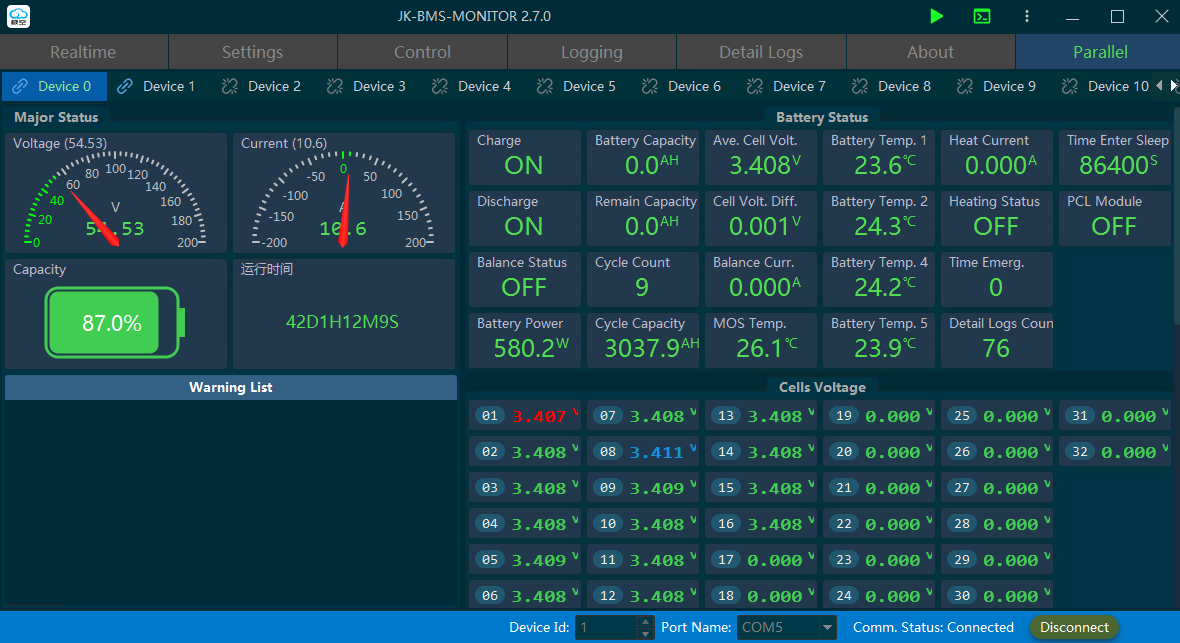
Yes PC App should be as good. https://i.postimg.cc/BbHYc9vK/JK-BMS-Monitor.png
- emilevirus
- Posts: 520
- Joined: 12 Aug 2020, 22:02
Re: "Simple" solution for Lithium charging
by shirley_hkg » 14 Nov 2025, 16:10
https://youtu.be/eZX7CkEEq_8?si=r2eSongqHwZiFyr4
This guy played a lots on JK bms.
Don't know the features of JK Inverter BMS .
This guy played a lots on JK bms.
Don't know the features of JK Inverter BMS .
- shirley_hkg
- Posts: 4643
- Joined: 31 Dec 2010, 13:42
Re: "Simple" solution for Lithium charging
by Burgerman » 14 Nov 2025, 17:17
Does the PC software connect via BT like the phone does?
Or is it only via serial?
Or is it only via serial?
-
Burgerman - Site Admin
- Posts: 70956
- Joined: 27 May 2008, 21:24
- Location: United Kingdom
Re: "Simple" solution for Lithium charging
by Burgerman » 14 Nov 2025, 19:23
JK-B2A8S20P HRC
Is needed if you plan to use a PC and the PC software to configure or setup or monitor.
At least I think!
It needs the HRC part on the end...
So that means it includes H for heating pad so you can charge in rediculous temperatures. Not really needed. And RS485 which means it can connect to other machines and software via serial or USB. Thats the R bit at the end. The C sc tands for customised.
Unless someone knows differently!
I would buy one but no way to find out! Would rather it used PC and BT.
https://www.aliexpress.com/item/1005010129448462.html specifically JK-B2A8S20PHRC
Is needed if you plan to use a PC and the PC software to configure or setup or monitor.
At least I think!
It needs the HRC part on the end...
So that means it includes H for heating pad so you can charge in rediculous temperatures. Not really needed. And RS485 which means it can connect to other machines and software via serial or USB. Thats the R bit at the end. The C sc tands for customised.
Unless someone knows differently!
I would buy one but no way to find out! Would rather it used PC and BT.
https://www.aliexpress.com/item/1005010129448462.html specifically JK-B2A8S20PHRC
-
Burgerman - Site Admin
- Posts: 70956
- Joined: 27 May 2008, 21:24
- Location: United Kingdom
Re: "Simple" solution for Lithium charging
by Burgerman » 14 Nov 2025, 20:00
This...
Seems to be the only way to connect to PC as BT only works of daft phones with tiny touch screens etc.
So theres that!
Seems to be the only way to connect to PC as BT only works of daft phones with tiny touch screens etc.
So theres that!
- Attachments
-
-
Burgerman - Site Admin
- Posts: 70956
- Joined: 27 May 2008, 21:24
- Location: United Kingdom
Re: "Simple" solution for Lithium charging
by rune » 15 Nov 2025, 00:21
I am using the JK-PB2A16S-20P
It's 200A, has the screen and extra interface bits and power on/off button. The Salsa M2 battery box I am fitting it in has space for it beside the battery without issue. The battery fits with it's longest sides orientated front to rear. I think these inverter BMS's are their latest spec models. Docan were able to supply this with the cells, so I didn't need to pay any extra shipping from China.
Yes, the 16s20p configuration is overkill, but it's what Docan had and going for the this means I get 2A balance and 200A rating. It also has two programmable relay outputs that can be triggered on various conditions, that I might use. I am thinking of connecting one to an inhibit line so that it's not possible to drive the chair when it has the charger plugged in, for example.
It's 200A, has the screen and extra interface bits and power on/off button. The Salsa M2 battery box I am fitting it in has space for it beside the battery without issue. The battery fits with it's longest sides orientated front to rear. I think these inverter BMS's are their latest spec models. Docan were able to supply this with the cells, so I didn't need to pay any extra shipping from China.
Yes, the 16s20p configuration is overkill, but it's what Docan had and going for the this means I get 2A balance and 200A rating. It also has two programmable relay outputs that can be triggered on various conditions, that I might use. I am thinking of connecting one to an inhibit line so that it's not possible to drive the chair when it has the charger plugged in, for example.
- rune
- Posts: 90
- Joined: 28 Jan 2013, 11:05
- Location: West Sussex, UK
Re: "Simple" solution for Lithium charging
by rune » 15 Nov 2025, 00:34
Burgerman wrote:JK-B2A8S20P HRC
Is needed if you plan to use a PC and the PC software to configure or setup or monitor.
The JK-PB2A16S-20P I have has PC and BT connection. It uses ASCII over serial over the BT connection. Also has CAN, RS232 and RS485. I don't see any reason the PC software wouldn't work over BT too as it's just serial over BT.
I am predominantly a Linux user, but a quick search found this, which may be of interest: https://community.element14.com/technol ... windows-10
Also, they provide a protocol spec, so it's simple to write code to control the thing directly, for example from an RPi or Arduino, if you have or want the need to do anything more fancy with it or interface it with anything else.
I intend to work out a solution to using the app remotely as well, so my daughters phone can connect to the BMS and I can then use the app to control it over the Internet. Should not be too complicated. There are already ways to tunnel the serial feed over a TCP socket.
- rune
- Posts: 90
- Joined: 28 Jan 2013, 11:05
- Location: West Sussex, UK
107 posts
• Page 1 of 4 • 1, 2, 3, 4
Return to Everything Powerchair
Who is online
Users browsing this forum: acid_coke, Juggler258 and 176 guests