On and on, the farce continues-
"We could soon be paying billions for this wind back-up
The National Grid's latest plan is taking off into the weirdest scheme yet, thanks to our politicians’ obsession with wind turbines."
http://www.telegraph.co.uk/earth/energy/10220083/We-could-soon-be-paying-billions-for-this-wind-back-up.html
"Occasionally, one comes across a story so mind-blowingly unexpected and out-of-left-field that it seems hard for readers to take on board that it is true. Such is the story I first reported here last month, under the heading, “Our lights will stay on, but it’ll cost us a fortune”, about the scheme being devised by the National Grid to solve what has long been the most intractable problem created by the Government’s plan to see the best part of £110 billion spent in seven years on building tens of thousands more wind turbines – namely, how to keep our national grid “balanced” when it has to cope with all those unpredictably wild fluctuations in the speed of the wind.
The answer National Grid has come up with, only made possible by the latest computer technology and “cloud software”, is to hook up thousands of diesel generators, remotely controlled by the grid, to provide almost instantly available back-up for when the wind drops. As we can see from recent reports, such as the National Grid’s draft consultation on “Demand Side Balancing Reserve and Supplemental Balancing Reserve”, this is now taking off into the weirdest and most ambitious scheme yet called into being by our politicians’ obsession with wind turbines. As uncovered by the tireless research of my colleague, Richard North, on his EU Referendum blog, owners of diesel generators are being incentivised with offers of astronomic fees to make them available to the grid – subsidies equivalent to up to 12 times the going rate for conventional electricity, and even, on very rare occasions, up to £15,000 per megawatt hour (MWh), or 300 times the normal rate of £50 per MWh.
Initially, this “short-term operating reserve” only envisaged relying on existing standby generators, many owned by public bodies such as hospitals, prisons and military installations – which stand to earn hundreds of millions of pounds from the Government, paid for by the rest of us as a “stealth tax” through our electricity bills. But so lucrative is the subsidy bonanza now being proposed that dozens of private firms, with names such as Renewable Energy Generation and Power Balancing Services, are flocking to cash in by building dedicated “virtual power stations”, capable of generating up to 20MW or more, knowing that they can expect up to £47,000 a year in “availability payments” for each MW of capacity, even before they have generated a single unit of power.
This solution to the “grid balancing” problem created by wind was pioneered in the US. The first firm to set up a “virtual power station” in Britain was UK Power Reserve, run by a former governor of Oklahoma, who was amazed to find the British offering subsidies seven times larger than those available in his native state. When last week I asked National Grid, Ofgem and others for an estimate of how much we will all be having to pay for this “balancing” scheme, the general response was that this is still too much a “work in progress” to allow for overall cost estimates – although National Grid has been quoted as suggesting that within two years it could be £1 billion a year, adding 5 per cent more to our already soaring electricity bills. But, without question, we are looking here at one of the most sure-fire moneymaking wheezes of our time – what one firm happily describes as “money for nothing”.
And the final irony, of course, is that those diesel generators chuck out almost as much, per unit, of that supposedly polluting CO2 as any of the coal-fired power stations our politicians want to see taxed and regulated out of existence."
LC
Global warming...
Re: Global warming...
 by Lord Chatterley » 04 Aug 2013, 23:06
- Lord Chatterley
- Posts: 2915
- Joined: 06 Jan 2010, 13:12
Re: Global warming...
by Lord Chatterley » 17 Aug 2013, 19:12
It has always been my opinion that the Climate Stasis movement is nothing more than a giant, government-sponsored fraud, however new evidence has persuaded me that the Climate Changers maybe on to something... 
http://stevengoddard.wordpress.com/2013/08/17/electron-microscopy-reveals-the-footprint-of-man-made-co2-molecules/
LC
http://stevengoddard.wordpress.com/2013/08/17/electron-microscopy-reveals-the-footprint-of-man-made-co2-molecules/
LC
- Lord Chatterley
- Posts: 2915
- Joined: 06 Jan 2010, 13:12
Re: Global warming...
by Lord Chatterley » 21 Sep 2013, 14:52
- Lord Chatterley
- Posts: 2915
- Joined: 06 Jan 2010, 13:12
Re: Global warming...
by Lord Chatterley » 12 Dec 2013, 23:59
This is a view you do not often hear [I have included some commerce links from the original text purely out of interest]-
LC
How I Became an Oil Champion, by Erin Connors, engineering student
Here’s the scene.
You’re at a party. You’ve just been introduced to someone and you’re making small talk and exchanging information. Where are you from? What brings you here? Work? What do you do for a living?
Easy questions, right? Not if you work in the oil industry—because you have every reason to expect a negative response when you answer them. You hesitate and shift your weight, preparing for the coming judgment. You answer, “I work at the refinery on the east side of town.” Your new acquaintance gives you a look that says: You work in the oil industry? You’re part of the problem. Not wanting to be impolite, he changes the topic rather than voice his disdain for how you have chosen to spend our life. The conversation moves on, but you’re left with a sour taste in your mouth. “Why is everyone always looking down on what I do—and why don’t I speak up and defend myself?”
Here’s what I’ve come to believe over the last year. The reason I didn’t speak up (I do now) is because on some level, I agreed with those who look down on our industry.
I had been educated to believe that this “other person,”—whether it be a peer, a Professor, or a new acquaintance—was correct. Since elementary school, my formal education, like most others’, has taught me that fossil fuels are a dangerous addiction that, while convenient in the short run, are destroying our planet in the long-run.
This “education” was partially countered by my real life experience working as an intern in the industry. My first job was at a refinery in Texas, where I learned about all the incredible products that are derived from oil, from milk cartons to medicine. I gained a lot more appreciation for how integral oil is to our lives. But I was conflicted, because even though I knew that the oil industry was important, I couldn’t refute the view that it was a dangerous addiction destroying the planet and that it should be replaced by a “sustainable” source of energy (such as solar, wind, and biofuels).
Neither could most of my co-workers nor even my company. Like just about every oil company, it conceded that we were environmentally bad (What other companies besides oil companies focus on “Corporate Citizenship?”) but promised to be a little less bad: attempting to lower CO2 emissions a little, attempting to making ourselves less “unsustainable,” etc. Something seemed wrong about all this, but I didn’t know what or why or how to find out.
But then last November, I stumbled across a flier for an upcoming debate, “Oil: Dangerous Addiction or Healthy Choice?”http://www.youtube.com/watch?v=TsKwZZisdlY&inf_contact_key=f9faa60952c74ceff185f4e7432daa9c260c96feeaf84ccdeaae335b322b6963 I was very familiar with the “dangerous addiction” argument, made by a Wisconsin professor, Dr. Dino Ress. But I had never heard the “healthy choice” argument, made by Alex Epstein of the Center for Industrial Progress.
Epstein explained how we used oil to improve our lives across the board—including by building a far safer, cleaner, and resource-rich environment—that we choose to use it because it generates the greatest portable fuel (and synthetic materials) ever devised—and that both the producers and consumers of oil are moral in choosing to improve life this way.
Most important, Epstein explained that, as humans, we should be chiefly concerned about the human environment. The energy we choose to use needs to be evaluated on the basis of improving our environment, not the environment of the prairie chicken. He stressed that although oil technology, like any technology, has challenges, if we look at the big picture it makes our planet a far, far better place to live for humans—and anyone who truly cares about our environment should appreciate the oil industry.
The debate taught me that the question that had been bothering me for some time—How could an industry so fundamental to improving our environment be “bad”?—was not the right question to ask. The right question to ask, about any industry, is—Does it improve the human environment? And for the oil industry, the answer to that is a resounding “YES.”
Suddenly I saw everything I knew about the industry in a new, clarifying framework—a moral framework that relates everything to the big-picture of human life. This was the first day of my education to become an advocate for the industry that I worked in, believed in, and finally, fully appreciated.
I wanted more. I consumed all of CIP’s existing material—I read old blog posts, I watched old debates, I listened to CIP’s podcast Power Hour.http://industrialprogress.com/category/podcasts/?inf_contact_key=75ff7204362e3daf54a07b33017b07aad39e997a38657b1708ad1ff13f7eb80c I also emailed Alex about my studies and he invited me to CIP’s Talent Factory classes, where I started to really expand my understanding by working to create my own content for CIP.
When I returned to work this past summer, I felt completely different. The noise at the refinery wasn’t just oil traveling through the pipes, it was the blood of civilization. Every day, humans continue to choose fossil fuel energy because it is one of the best forms of energy, and I work at a refinery, helping people to use that energy.
This is my final year of college. Now, when someone asks me about my future job, I proudly state that I am going to be working in the oil industry. When someone makes a comment about how I’ve “sold my soul,” I know how to explain to them that I have, in fact, not “sold my soul” but I am actually very excited to be working in one of the most productive industries “improving my soul” and the planet.
Without the moral case for the oil industry, I would not have been able to do that. And that’s why I was excited to learn, a few weeks ago, that Alex had created a new “Oil Champion Kit” to help anyone become an oil champion as quickly as possible. You can learn more about it here.http://industrialprogress.com/oilchampion/?inf_contact_key=58af91927be7037a6355b2fcf98397a87b812326f23bf4294c696d2e1ffdcb25 I wish I had this been given the information in the Oil Champion Kit my first day at the refinery. I wish all my coworkers—from operators to other engineers to my supervisors—had this information. I hope that someday, it’s taught to every employee at every company. But for now, you can get it for yourself or your co-workers.
I hope my experience inspires others to learn as much as they can about the moral case for our industry. http://industrialprogress.com/moralcase/?inf_contact_key=707fcc52249f5256b0b31fc4821e0d57b6b1380a848e0c8a310fe55bca60d2baI hope that when I start my full-time position next summer that I am able to take part in a new dialogue on how to spread the moral case for our industry, which will only be possible if hundreds of people take this opportunity to become an Oil Champion. Now, go be the change you want to see—be an Oil Champion!
LC
How I Became an Oil Champion, by Erin Connors, engineering student
Here’s the scene.
You’re at a party. You’ve just been introduced to someone and you’re making small talk and exchanging information. Where are you from? What brings you here? Work? What do you do for a living?
Easy questions, right? Not if you work in the oil industry—because you have every reason to expect a negative response when you answer them. You hesitate and shift your weight, preparing for the coming judgment. You answer, “I work at the refinery on the east side of town.” Your new acquaintance gives you a look that says: You work in the oil industry? You’re part of the problem. Not wanting to be impolite, he changes the topic rather than voice his disdain for how you have chosen to spend our life. The conversation moves on, but you’re left with a sour taste in your mouth. “Why is everyone always looking down on what I do—and why don’t I speak up and defend myself?”
Here’s what I’ve come to believe over the last year. The reason I didn’t speak up (I do now) is because on some level, I agreed with those who look down on our industry.
I had been educated to believe that this “other person,”—whether it be a peer, a Professor, or a new acquaintance—was correct. Since elementary school, my formal education, like most others’, has taught me that fossil fuels are a dangerous addiction that, while convenient in the short run, are destroying our planet in the long-run.
This “education” was partially countered by my real life experience working as an intern in the industry. My first job was at a refinery in Texas, where I learned about all the incredible products that are derived from oil, from milk cartons to medicine. I gained a lot more appreciation for how integral oil is to our lives. But I was conflicted, because even though I knew that the oil industry was important, I couldn’t refute the view that it was a dangerous addiction destroying the planet and that it should be replaced by a “sustainable” source of energy (such as solar, wind, and biofuels).
Neither could most of my co-workers nor even my company. Like just about every oil company, it conceded that we were environmentally bad (What other companies besides oil companies focus on “Corporate Citizenship?”) but promised to be a little less bad: attempting to lower CO2 emissions a little, attempting to making ourselves less “unsustainable,” etc. Something seemed wrong about all this, but I didn’t know what or why or how to find out.
But then last November, I stumbled across a flier for an upcoming debate, “Oil: Dangerous Addiction or Healthy Choice?”http://www.youtube.com/watch?v=TsKwZZisdlY&inf_contact_key=f9faa60952c74ceff185f4e7432daa9c260c96feeaf84ccdeaae335b322b6963 I was very familiar with the “dangerous addiction” argument, made by a Wisconsin professor, Dr. Dino Ress. But I had never heard the “healthy choice” argument, made by Alex Epstein of the Center for Industrial Progress.
Epstein explained how we used oil to improve our lives across the board—including by building a far safer, cleaner, and resource-rich environment—that we choose to use it because it generates the greatest portable fuel (and synthetic materials) ever devised—and that both the producers and consumers of oil are moral in choosing to improve life this way.
Most important, Epstein explained that, as humans, we should be chiefly concerned about the human environment. The energy we choose to use needs to be evaluated on the basis of improving our environment, not the environment of the prairie chicken. He stressed that although oil technology, like any technology, has challenges, if we look at the big picture it makes our planet a far, far better place to live for humans—and anyone who truly cares about our environment should appreciate the oil industry.
The debate taught me that the question that had been bothering me for some time—How could an industry so fundamental to improving our environment be “bad”?—was not the right question to ask. The right question to ask, about any industry, is—Does it improve the human environment? And for the oil industry, the answer to that is a resounding “YES.”
Suddenly I saw everything I knew about the industry in a new, clarifying framework—a moral framework that relates everything to the big-picture of human life. This was the first day of my education to become an advocate for the industry that I worked in, believed in, and finally, fully appreciated.
I wanted more. I consumed all of CIP’s existing material—I read old blog posts, I watched old debates, I listened to CIP’s podcast Power Hour.http://industrialprogress.com/category/podcasts/?inf_contact_key=75ff7204362e3daf54a07b33017b07aad39e997a38657b1708ad1ff13f7eb80c I also emailed Alex about my studies and he invited me to CIP’s Talent Factory classes, where I started to really expand my understanding by working to create my own content for CIP.
When I returned to work this past summer, I felt completely different. The noise at the refinery wasn’t just oil traveling through the pipes, it was the blood of civilization. Every day, humans continue to choose fossil fuel energy because it is one of the best forms of energy, and I work at a refinery, helping people to use that energy.
This is my final year of college. Now, when someone asks me about my future job, I proudly state that I am going to be working in the oil industry. When someone makes a comment about how I’ve “sold my soul,” I know how to explain to them that I have, in fact, not “sold my soul” but I am actually very excited to be working in one of the most productive industries “improving my soul” and the planet.
Without the moral case for the oil industry, I would not have been able to do that. And that’s why I was excited to learn, a few weeks ago, that Alex had created a new “Oil Champion Kit” to help anyone become an oil champion as quickly as possible. You can learn more about it here.http://industrialprogress.com/oilchampion/?inf_contact_key=58af91927be7037a6355b2fcf98397a87b812326f23bf4294c696d2e1ffdcb25 I wish I had this been given the information in the Oil Champion Kit my first day at the refinery. I wish all my coworkers—from operators to other engineers to my supervisors—had this information. I hope that someday, it’s taught to every employee at every company. But for now, you can get it for yourself or your co-workers.
I hope my experience inspires others to learn as much as they can about the moral case for our industry. http://industrialprogress.com/moralcase/?inf_contact_key=707fcc52249f5256b0b31fc4821e0d57b6b1380a848e0c8a310fe55bca60d2baI hope that when I start my full-time position next summer that I am able to take part in a new dialogue on how to spread the moral case for our industry, which will only be possible if hundreds of people take this opportunity to become an Oil Champion. Now, go be the change you want to see—be an Oil Champion!
- Lord Chatterley
- Posts: 2915
- Joined: 06 Jan 2010, 13:12
Re: Global warming...
by Burgerman » 13 Dec 2013, 14:16
https://www.youtube.com/watch?v=8BQpciw8suk#t=277
The "hockey stick" graph, that most of the bullshit is based on.
The "hockey stick" graph, that most of the bullshit is based on.
-

Burgerman - Site Admin
- Posts: 71086
- Joined: 27 May 2008, 21:24
- Location: United Kingdom
Re: Global warming...
by Lord Chatterley » 13 Dec 2013, 17:06
Alex Epstein interview with Dr. Ross McKitrick who, with Dr. Stephen McIntyre, debunked the famous “Hockey Stick” graph used by the IPCC, Al Gore, and just about every other person and organization pushing for government action in the face of purportedly catastrophic global warming.
http://industrialprogress.com/2013/10/18/power-hour-the-man-who-debunked-the-hockey-stick/
LC
http://industrialprogress.com/2013/10/18/power-hour-the-man-who-debunked-the-hockey-stick/
LC
- Lord Chatterley
- Posts: 2915
- Joined: 06 Jan 2010, 13:12
Re: Global warming...
by Lord Chatterley » 20 Dec 2013, 14:32
If these 'climate scientists' were working in business they would be serving serious jail time.
http://wattsupwiththat.com/2009/11/28/understanding-climategate-whos-who-a-video/
LC
http://wattsupwiththat.com/2009/11/28/understanding-climategate-whos-who-a-video/
LC
- Lord Chatterley
- Posts: 2915
- Joined: 06 Jan 2010, 13:12
Re: Global warming...
by Burgerman » 26 Dec 2013, 18:26
The earth has been here 4.5 BILLION years. So looking back just 500million is recent history. Even that shows the temps today are not at all extreme.

Remember that we have only been around 1 million, and have only been burning fossil fuels for a few generations! Such a short time that it wouldn't even show on this longer time period graph. The global warmists "hockey stick" graph only looks bad because they are choosing to look at a tiny bit on the end of a much bigger graph. But if they showed you that then they would look silly.
Global warming happens. It may be happening now. But to say its unusual or faster than before, is a joke! Its not even noticeable in the long term view. To see any "aberration" at all you need to look at a carefully chosen tiny bit of the graph that only shows what amounts to about the last 2 seconds of history from thousands of years...
Talking about hundreds or thousands of years is pointless. Even millions of years is too short to see the big picture. You need to be looking at hundreds of millions. To the earth that's about a day.
Remember that we have only been around 1 million, and have only been burning fossil fuels for a few generations! Such a short time that it wouldn't even show on this longer time period graph. The global warmists "hockey stick" graph only looks bad because they are choosing to look at a tiny bit on the end of a much bigger graph. But if they showed you that then they would look silly.
Global warming happens. It may be happening now. But to say its unusual or faster than before, is a joke! Its not even noticeable in the long term view. To see any "aberration" at all you need to look at a carefully chosen tiny bit of the graph that only shows what amounts to about the last 2 seconds of history from thousands of years...
Talking about hundreds or thousands of years is pointless. Even millions of years is too short to see the big picture. You need to be looking at hundreds of millions. To the earth that's about a day.
-
Burgerman - Site Admin
- Posts: 71086
- Joined: 27 May 2008, 21:24
- Location: United Kingdom
Re: Global warming...
by Burgerman » 06 Jan 2014, 16:48
-
Burgerman - Site Admin
- Posts: 71086
- Joined: 27 May 2008, 21:24
- Location: United Kingdom
Re: Global warming...
by Burgerman » 06 Jan 2014, 17:03
I see the US mid west and Canada is having record cold again breaking all records...
More global warming then. And that no teenagers alive today have seen any rising temperatures! Just the opposite.
More global warming then. And that no teenagers alive today have seen any rising temperatures! Just the opposite.
-
Burgerman - Site Admin
- Posts: 71086
- Joined: 27 May 2008, 21:24
- Location: United Kingdom
Re: Global warming...
by Lord Chatterley » 13 Apr 2014, 16:38
Kid refused A-level for being too rational.
http://www.telegraph.co.uk/earth/environment/climatechange/10761597/No-A-level-for-climate-change-denier.html
LC
http://www.telegraph.co.uk/earth/environment/climatechange/10761597/No-A-level-for-climate-change-denier.html
LC
- Lord Chatterley
- Posts: 2915
- Joined: 06 Jan 2010, 13:12
Re: Global warming...
by Burgerman » 13 Apr 2014, 18:02
I study climate change in huge detail for many years. I think its all overblown hysterical bullshit. And I am not alone, there are a lot of scientists that agree with me. Its only those on the pay roll that seem to think otherwise. There are plenty of non brainwashed government's with independent scientists that agree with me such as the Japanese, and are also "deniers"... If a denier is someone that has studied the evidence and think its bollocks!
Its real and has been happening in far more extreme, and faster ways for billions of years.
What is definitely unproven, and really isn't tested or even remotely certain is the affect of OUR tiny contribution to this, if any.
True there are plenty of climate models, that show that we may or may not be contributing. But we do not know all or even most of the parameters, or the affect of these changes, and a tiny difference of DATA input, results in wildly different output results. So these models basically can say whatever the person running them wants them to say.
And. There's also no real evidence that even if true, and we don't know that it is, that the net result of warming, man made or otherwise is BAD! There are rather a lot of reasons with very good evidence that the opposite is true overall.
And.
There isn't an alternative anyway.
Its real and has been happening in far more extreme, and faster ways for billions of years.
What is definitely unproven, and really isn't tested or even remotely certain is the affect of OUR tiny contribution to this, if any.
True there are plenty of climate models, that show that we may or may not be contributing. But we do not know all or even most of the parameters, or the affect of these changes, and a tiny difference of DATA input, results in wildly different output results. So these models basically can say whatever the person running them wants them to say.
And. There's also no real evidence that even if true, and we don't know that it is, that the net result of warming, man made or otherwise is BAD! There are rather a lot of reasons with very good evidence that the opposite is true overall.
And.
There isn't an alternative anyway.
-
Burgerman - Site Admin
- Posts: 71086
- Joined: 27 May 2008, 21:24
- Location: United Kingdom

Re: Global warming...
by Lord Chatterley » 26 Apr 2014, 13:05
At last, an environmentally friendly solution to all our transportation problems - the Envia Discord 2015.
http://www.frontpagemag.com/2014/dgreenfield/introducing-the-envia-discord-2015/?utm_source=rss&utm_medium=rss&utm_campaign=introducing-the-envia-discord-2015
LC
http://www.frontpagemag.com/2014/dgreenfield/introducing-the-envia-discord-2015/?utm_source=rss&utm_medium=rss&utm_campaign=introducing-the-envia-discord-2015
LC
- Lord Chatterley
- Posts: 2915
- Joined: 06 Jan 2010, 13:12
Re: Global warming...
by sacharlie » 02 May 2014, 03:10
Lord Chatterley wrote:At last, an environmentally friendly solution to all our transportation problems - the Envia Discord 2015.
http://www.frontpagemag.com/2014/dgreenfield/introducing-the-envia-discord-2015/?utm_source=rss&utm_medium=rss&utm_campaign=introducing-the-envia-discord-2015
LC
WOW
Did you guys running Windows OS get infected from that link? I read about the Discord but clicked on another title on that page and my system shut down and I had to log in again. No biggy it just does that when something is amiss. I surf the internet with a Chrome browser a top an Android OS; no virus, no malware & no ticks or fleas.
- sacharlie
- Posts: 1801
- Joined: 01 Aug 2010, 18:52
- Location: USA
Re: Global warming...
by Burgerman » 02 May 2014, 10:09
Nope. Nothing found. I just clicked it again. Just a few ad tracking cookies etc. Its clean.
Win7 64 and IE11
Its not supposed to... Something is amiss. Probably that browser. That sites got a PR6 so is of high quality and has a lot of incoming links.
Win7 64 and IE11
No biggy it just does that when something is amiss.
Its not supposed to... Something is amiss. Probably that browser. That sites got a PR6 so is of high quality and has a lot of incoming links.
-
Burgerman - Site Admin
- Posts: 71086
- Joined: 27 May 2008, 21:24
- Location: United Kingdom
Re: Global warming...
by falco peregrinus » 24 May 2014, 11:45
37% of Americans believe that global warming is a hoax - and here's why.
http://www.scientificamerican.com/artic ... -theories/
Falco
http://www.scientificamerican.com/artic ... -theories/
Falco
-

falco peregrinus - Posts: 445
- Joined: 16 Sep 2013, 11:19
- Location: Brisbane, Australia
Re: Global warming...
by Burgerman » 24 May 2014, 15:57
I don't believe in man made global warming. Based on real science and evidence. Nothing to do with crackpot conspiracy theories. I am the most rational, evidence based, cold, pure skeptic that can sort fact from bull you will ever meet. And I study REAL science, physics and understand a hell of a lot of it.
There are a great many good logical reasoning scientists, that are NOT on the IPCC payroll that think the same things as I do. Or these FOUR independent SEPERATE things:
1) The way temperature measurements are taken and recorded long term is inaccurate. Because as areas where temp are recorded get built up and concreted/paved over you get artificial hot areas in the places the measurements are taken so these tend to increase over time. There's a lot of very good evidence for this. However I think the world is warming RECENTLY - although has cooled for the last decade hence the renaming to climate change - (but nothing compared to the distant past) - but its warming less so than the warmists claim based on the REAL and substantial evidence from other sources. The problem with the IPCC is that because they are all PAID to find links, and funding stops when they stand up and say - err, we were wrong, they cherry pick the data they like. And massage computer models to show they are right.
2) That the climate is warming, again compared to DISTANT past, not so much recently, but its not even slightly significant. Unless you limit billions of years of change to looking at only a few hundred recent years... looking at a 4.7 billion year old planet and only looking at the last few years (the hockey stick) is like looking only at the last 2 pages of a London telephone directory and ignoring 1000 previous pages.
And so what! warming is not caused by CO2. In fact just the opposite can be shown to be true. The same correlation works both ways. When you warm any mass of water like the seas, C02 is released in the same way that it is from a beer as that warms. CO2 FOLLOWS the completely natural temperature rise. And there's a LOT of evidence to show this is also a distinct possibility. What's more, the plant life, and algae, simply spreads further north, and south, and grows better elsewhere and locks it all up as wood again... (and eventually coal, oil etc) So a short term blip for a few hundred years is irrelevant in the scheme of things. There is just 0.02 percent Co2 in the atmosphere! And at one time there was almost 15 percent. That's a huge difference. And what's more water vapour is a much more important greenhouse gas, and that's many 1000s of times more abundant and variable in the atmosphere. So the case for CO2 is NOT yet close to being concluded, other than the climate change panel warmists that are paid to find links.
3) Most of this planets history in geological time has been vastly colder with ice ages that have lasted millions of years at a time, with ice over much of the northern hemisphere. And ice miles thick as far down as new York. THIS is the normal state of affairs for the earth. The short warm periods, where life, trees, and all the good stuff happens are the odd bits out. The warmer the planet is the better life does. So who says warmer is a bad THING?????? I disagree. Most of this planets history it has been too cold to live on. And some of the warm bits, where life flourishes, don't last long.
4) Even if the warmest alarmists are right, and even if warmer is worse (both wrong incidentally) there's NOTHING we can do about it. So why not continue with what we are doing? What would YOU do about it? Because other than ruining the economy, the ability to feed 7 billion people which requires fuel and machinery and industrial farming and so on, there's LITERALLY no choice anyway.
viewtopic.php?f=5&t=1175&p=54802#p49118
How does your warmist religion, explain this?
Replies on a postcard to:
Rational Logical Thinking sceptical Society, Westlands Avenue, Grimsby.
There are a great many good logical reasoning scientists, that are NOT on the IPCC payroll that think the same things as I do. Or these FOUR independent SEPERATE things:
1) The way temperature measurements are taken and recorded long term is inaccurate. Because as areas where temp are recorded get built up and concreted/paved over you get artificial hot areas in the places the measurements are taken so these tend to increase over time. There's a lot of very good evidence for this. However I think the world is warming RECENTLY - although has cooled for the last decade hence the renaming to climate change - (but nothing compared to the distant past) - but its warming less so than the warmists claim based on the REAL and substantial evidence from other sources. The problem with the IPCC is that because they are all PAID to find links, and funding stops when they stand up and say - err, we were wrong, they cherry pick the data they like. And massage computer models to show they are right.
2) That the climate is warming, again compared to DISTANT past, not so much recently, but its not even slightly significant. Unless you limit billions of years of change to looking at only a few hundred recent years... looking at a 4.7 billion year old planet and only looking at the last few years (the hockey stick) is like looking only at the last 2 pages of a London telephone directory and ignoring 1000 previous pages.
And so what! warming is not caused by CO2. In fact just the opposite can be shown to be true. The same correlation works both ways. When you warm any mass of water like the seas, C02 is released in the same way that it is from a beer as that warms. CO2 FOLLOWS the completely natural temperature rise. And there's a LOT of evidence to show this is also a distinct possibility. What's more, the plant life, and algae, simply spreads further north, and south, and grows better elsewhere and locks it all up as wood again... (and eventually coal, oil etc) So a short term blip for a few hundred years is irrelevant in the scheme of things. There is just 0.02 percent Co2 in the atmosphere! And at one time there was almost 15 percent. That's a huge difference. And what's more water vapour is a much more important greenhouse gas, and that's many 1000s of times more abundant and variable in the atmosphere. So the case for CO2 is NOT yet close to being concluded, other than the climate change panel warmists that are paid to find links.
3) Most of this planets history in geological time has been vastly colder with ice ages that have lasted millions of years at a time, with ice over much of the northern hemisphere. And ice miles thick as far down as new York. THIS is the normal state of affairs for the earth. The short warm periods, where life, trees, and all the good stuff happens are the odd bits out. The warmer the planet is the better life does. So who says warmer is a bad THING?????? I disagree. Most of this planets history it has been too cold to live on. And some of the warm bits, where life flourishes, don't last long.
4) Even if the warmest alarmists are right, and even if warmer is worse (both wrong incidentally) there's NOTHING we can do about it. So why not continue with what we are doing? What would YOU do about it? Because other than ruining the economy, the ability to feed 7 billion people which requires fuel and machinery and industrial farming and so on, there's LITERALLY no choice anyway.
viewtopic.php?f=5&t=1175&p=54802#p49118
How does your warmist religion, explain this?
Replies on a postcard to:
Rational Logical Thinking sceptical Society, Westlands Avenue, Grimsby.
-
Burgerman - Site Admin
- Posts: 71086
- Joined: 27 May 2008, 21:24
- Location: United Kingdom
Re: Global warming...
by Burgerman » 24 May 2014, 19:05

Try looking at temperatures over the LONG term instead of a minute irrelevant blip (which has stopped anyway for 10 years) to get a real perspective!
-
Burgerman - Site Admin
- Posts: 71086
- Joined: 27 May 2008, 21:24
- Location: United Kingdom

Re: Global warming...
by Burgerman » 24 May 2014, 19:08
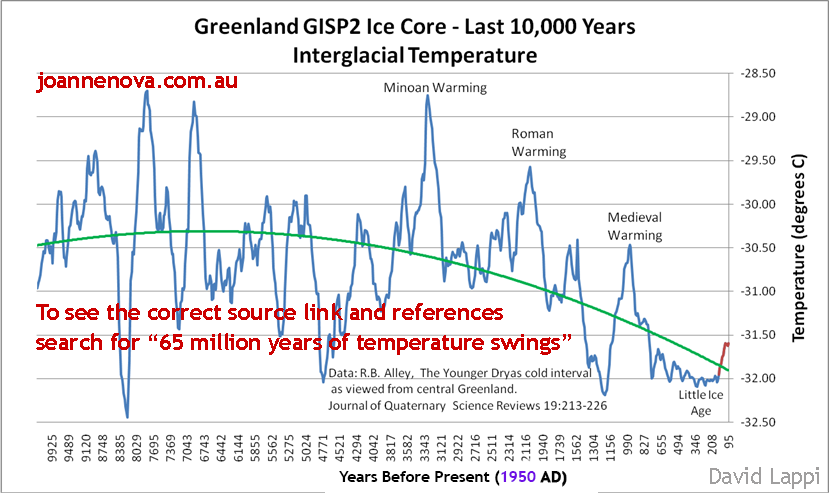
The recent 10 thousand years... Note the HUGE RED SPIKE!!!
Get some perspective. That spike looks "big" if you only look at recent years.
-
Burgerman - Site Admin
- Posts: 71086
- Joined: 27 May 2008, 21:24
- Location: United Kingdom
Re: Global warming...
by Burgerman » 24 May 2014, 19:12
http://www.youtube.com/watch?v=DFbUVBYIPlI
The recent 1500 years... The last little spike now looks "significant"!!!
Watch. Its dead short, and shows the extent of this craziness in simple graphics.
And we still have both poles, and polar bears.
The recent 1500 years... The last little spike now looks "significant"!!!
Watch. Its dead short, and shows the extent of this craziness in simple graphics.
And we still have both poles, and polar bears.
-
Burgerman - Site Admin
- Posts: 71086
- Joined: 27 May 2008, 21:24
- Location: United Kingdom
Re: Global warming...
by Burgerman » 24 May 2014, 19:20
Where has your "warming" and alarmist scare mongering gone now?
Try looking at all the data and then saying we have "unusual" warming.
There's plenty of other evidence to show the same thing too. How much time do you have?
What's happening is we are getting legislation based evidence rather than evidence based legislation. And there are so many people now "believers" and that are caught up in it financially and in other ways that nobody is ALOWED to stand up and say its all bollocks. Or just like those that deny a god exists you are a denier.
Climate models prove nothing. Other than that they are extremely touchy and depending on data in, and exact algo, can say ANYTHING.
Try looking at all the data and then saying we have "unusual" warming.
There's plenty of other evidence to show the same thing too. How much time do you have?
What's happening is we are getting legislation based evidence rather than evidence based legislation. And there are so many people now "believers" and that are caught up in it financially and in other ways that nobody is ALOWED to stand up and say its all bollocks. Or just like those that deny a god exists you are a denier.
Climate models prove nothing. Other than that they are extremely touchy and depending on data in, and exact algo, can say ANYTHING.
-
Burgerman - Site Admin
- Posts: 71086
- Joined: 27 May 2008, 21:24
- Location: United Kingdom
Re: Global warming...
by falco peregrinus » 25 May 2014, 16:37
Get some perspective. That spike looks "big" if you only look at recent years.
My initial thought on the relative heights of the peaks is that (1) the size of the peaks and shape of the graph suggests larger differences between the heights of the peaks than referral to the scale on the right hand side indicates is reality, and (2) since all the world's governments are refusing to do anything that will slow the temperature rise over the coming centuries, then the height of the graph at 2014 is not important. What is important is how high the temperature will rise over the next couple of hundred years. And of course there will be ups and downs over the next couple of hundred years - not every year will be up. It's the trend that is important, and whether there is any real prospect of the trend flattening or reversing.
Burgerman, you've got your arsenal of facts at your fingertips, and your brain still works well. (Half your luck! I wish mine still did!) I don't have an arsenal of facts at my fingertips any longer, and my brain no longer works well. Eight years ago (before the ABI) I researched the topic thoroughly and read all the IPCC reports cover to cover. I drew my conclusions, then did no further research on the subject. Everything I gathered together then is now I-don't-know-where. I've forgotten most of what I read then, and where I read it. From what I've seen here and on the internet in the last few days, there's clearly been a lot more and very valuable research done in the last eight years, which I'm not entirely sure I really want to spend the time and effort and emotion hunting out and reading. As it is now, I can't find my desk for all the pieces of paper spread out all over it telling me what I should be doing right now instead of writing this.
My concern about climate change is based upon the most-up-to-date research that was available on the topic eight years ago. Perhaps that research has now been superceded with contradicting evidence, but to me the picture today seems to be more the way that it is with most scientific research in most disciplines - for each theory that exists, there is evidence that supports that theory, but also evidence that suggests that that theory is not the entire explanation, if any part of the explanation at all. In most scientific disciplines, there exists multiple different theories, all supported by some evidence, but all contradicted by other evidence, and no one theory explains everything.
The concern with climate change is, by the time all the evidence is in that will convince governments that they should do something, it will be too late for them to do anything worthwhile at all. In fact, if IPCC were right in what they said eight years ago, there's no point discussing or researching climate change at all, because it's already too damned late to do anything about it!
Maybe I'll spend some time getting up to date with the issue, but I doubt it. Thinking is too hard these days, and I've got mountains of other stuff I should really be doing. I don't know. It's not important any more. I'm distressed that my kids will experience the violent weather and environmental changes that are inevitable during their lifetimes, but I'll be dead and gone before the worst of the changes ahead arrive, so it won't affect me very much.
Falco
-
falco peregrinus - Posts: 445
- Joined: 16 Sep 2013, 11:19
- Location: Brisbane, Australia
Re: Global warming...
by Burgerman » 25 May 2014, 18:42
The concern with climate change is, by the time all the evidence is in that will convince governments that they should do something, it will be too late for them to do anything worthwhile at all. In fact, if IPCC were right in what they said eight years ago, there's no point discussing or researching climate change at all, because it's already too damned late to do anything about it!
Correct. Even if they ARE correct, and that is absolutely not a forgone conclusion contrary to the way the media and IPCC idiots tell it, its already to late to do anything.
Lets say for the sake of argument they are correct.
Then:
- Who says that warming isn't BETTER??? Yes there will be disruption over many lifetimes, but warm periods are when humans and animals and plant life does BETTER overall.
- That we CAN do anything about it without the impact on our way of life? You know the one that gives us the huge life expectancy, heat, security, comfort, and ability to feed everyone?
Realistically then its easier to relocate a few people in centuries to come, build sea defences as required (if required) and carry on as we are. If fact there's no choice.
But more importantly we DO NOT know that any warming IS caused by us, and in the longer term view its minute,. insignificant, and lost in the noise! Its only significant when you choose to look at just the last few years. A look at the longer term shows its not worthy of mention. So why are we bankrupting society for something both unproven, untestable, and inevitable with or without us? Its ridiculous.
Incidentally my arsenal of facts consisted of a quick look on the web for long term temperatures. Took 20 secs. The IPCC data is both flawed, and unlike real science uses evidence to prop up a goal. Meaning that they all KNOW global warming is real (it is if you look just at recent years, ignoring the last 12) and they all KNOW its caused by CO2 (debatable by real scientists, and not testable as there are too many unknown variables that their computer models cannot take into account). In other words they already have their result and work on data to justify it. All caused by Margaret thatcher paying scientists to discredit coal as a fuel during the miners strike. Once the ball got rolling and many jobs and industries started to depend on it, it became like a religion.
-
Burgerman - Site Admin
- Posts: 71086
- Joined: 27 May 2008, 21:24
- Location: United Kingdom
Re: Global warming...
by Burgerman » 27 May 2014, 16:48
-
Burgerman - Site Admin
- Posts: 71086
- Joined: 27 May 2008, 21:24
- Location: United Kingdom
Re: Global warming...
by Burgerman » 02 Jun 2014, 14:40
http://www.wheelchairdriver.com/warming.pdf
Why no line up of warmists waiting to tell me what's wrong with this?
Why no line up of warmists waiting to tell me what's wrong with this?
-
Burgerman - Site Admin
- Posts: 71086
- Joined: 27 May 2008, 21:24
- Location: United Kingdom
Re: Global warming...
by falco peregrinus » 02 Jun 2014, 18:02
Too much work. Too much research and thinking required. Too much time required to get back on top of the current state of research on the subject. Flat out surviving one day at a time (or sometimes just one hour at a time); too busy doing that to commit to researching this topic all over again.
Briefly though, as I think I might have said before, the concern is with the predictions for the future and the evidence that supports those predictions and the statistical calculations that estimate the likelihood of those predictions being correct. The concern is not with the conditions at present or in the recent past.
That said, we here in Brisbane have just had our warmest May on record.
Don't take our silence as submission or agreement.
Falco
Briefly though, as I think I might have said before, the concern is with the predictions for the future and the evidence that supports those predictions and the statistical calculations that estimate the likelihood of those predictions being correct. The concern is not with the conditions at present or in the recent past.
That said, we here in Brisbane have just had our warmest May on record.
Don't take our silence as submission or agreement.
Falco
-
falco peregrinus - Posts: 445
- Joined: 16 Sep 2013, 11:19
- Location: Brisbane, Australia
Who is online
Users browsing this forum: No registered users and 16 guests
