i dont quite get it - but will try what i think i understand -
once i remove the cable - and its loose - then i take my volt meter - at 200 ohms like when i check the volts of a pack etc, -
using just the black cable from the meter - you want me to touch the black cable from end to end and see what it says on the meter
will do tomorrow
PINNED - Lithium battery conversion/info
Re: Step by step lithium conversion?
 by Burgerman » 09 Mar 2016, 02:30
Yes. Then the red wire. Then we know that the cable and connectors and fuses are good.
-

Burgerman - Site Admin
- Posts: 71096
- Joined: 27 May 2008, 21:24
- Location: United Kingdom
Re: Step by step lithium conversion?
by expresso » 09 Mar 2016, 02:40
ok got it - will do tomorrow -
now that i know - will check after i make any more the same way
now that i know - will check after i make any more the same way
Quickie 636 - 230ah LifePo4
- expresso
- Posts: 11985
- Joined: 10 May 2010, 03:17
Re: Step by step lithium conversion?
by Burgerman » 09 Mar 2016, 02:43
You can check any wire, fuse, etc. If it checks out then I will tell you what to do next.
-
Burgerman - Site Admin
- Posts: 71096
- Joined: 27 May 2008, 21:24
- Location: United Kingdom
Re: Step by step lithium conversion?
by expresso » 09 Mar 2016, 02:47
ok thanks - it may be my wire - - i will check both my wire - and the connector on the BMS end also -
that should read the pack Volt - 27V etc, - then i know thats ok - only thing else it can be is my wire if that checks out -
i was ready to charge with the PL 8 - do i disconnect the ADD On from the Chair to check it ? or doest matter - the BMS connector that is
that should read the pack Volt - 27V etc, - then i know thats ok - only thing else it can be is my wire if that checks out -
i was ready to charge with the PL 8 - do i disconnect the ADD On from the Chair to check it ? or doest matter - the BMS connector that is
Quickie 636 - 230ah LifePo4
- expresso
- Posts: 11985
- Joined: 10 May 2010, 03:17
Re: Step by step lithium conversion?
by Burgerman » 09 Mar 2016, 10:30
I cant tell you. I cant see what you are doing and dont know whats connected to what.
-
Burgerman - Site Admin
- Posts: 71096
- Joined: 27 May 2008, 21:24
- Location: United Kingdom
Re: Step by step lithium conversion?
by expresso » 09 Mar 2016, 17:00
Ok first charge with PL 8 - it wasnt empty - to begin with -
Quickie 636 - 230ah LifePo4
- expresso
- Posts: 11985
- Joined: 10 May 2010, 03:17
Re: Step by step lithium conversion?
by Burgerman » 09 Mar 2016, 17:31
1. What was wrong?
2. What are you charging? Lead Batteries or Addon? Or Both?
3. Did the BMS finish balancing?
4. Did the PL8 end correctly with no errors?
Because the BMS + Battery Preset was set to a very safe figure to test initially to be sure the BMS worked correctly and to be sure the 2 sets of batteries ended correctly.
Post the Amps graph. Or email me the full saved graph data.
If this was for BOTH lead and addon, then you will now need to change the settings slightly to give a more complete charge. 2 things to adjust.
Charge voltage up slightly to 2.35v per cell. And termination point lower as discussed in a previous post. Post all the rest in the AddOn thread.
2. What are you charging? Lead Batteries or Addon? Or Both?
3. Did the BMS finish balancing?
4. Did the PL8 end correctly with no errors?
Because the BMS + Battery Preset was set to a very safe figure to test initially to be sure the BMS worked correctly and to be sure the 2 sets of batteries ended correctly.
Post the Amps graph. Or email me the full saved graph data.
If this was for BOTH lead and addon, then you will now need to change the settings slightly to give a more complete charge. 2 things to adjust.
Charge voltage up slightly to 2.35v per cell. And termination point lower as discussed in a previous post. Post all the rest in the AddOn thread.
-
Burgerman - Site Admin
- Posts: 71096
- Joined: 27 May 2008, 21:24
- Location: United Kingdom
Re: Step by step lithium conversion?
by expresso » 12 Apr 2016, 23:57
Just to let everyone know - the seller on ebay has returned and has the correct rubber caps for the Cells -
http://www.ebay.com/itm/100-BLACK-SOCKE ... 2087848890?
get them if you need them for now and later - i managed to get a few more hundred just to keep for future packs never know
http://www.ebay.com/itm/100-BLACK-SOCKE ... 2087848890?
get them if you need them for now and later - i managed to get a few more hundred just to keep for future packs never know
Quickie 636 - 230ah LifePo4
- expresso
- Posts: 11985
- Joined: 10 May 2010, 03:17
Re: Step by step lithium conversion?
by JoJo7 » 22 Apr 2016, 01:52
I am designing a 560 Whr lithium iron phosphate battery pack to supplement the 2 group 24 batteries on my Permobil M. 300 wheelchair. I want to check my understanding of lithium cell balancing and I have a couple of questions:
1) suppose I use 16 10Ahr cells (2 parallel chains, 8 cells each chain). If I understand Burgerman's method of sorting and wiring his cells (described in the beginning of this thread), it seems that the important thing is that all the cells in a particular series chain are well matched in terms of capacity. Capacity matching of one chain to the other does not seem important. I have illustrated this with an attached drawing where I pretty much made up the numbers for variability of cell capacities. Is this correct?
2) if, instead, I used a single chain of 8 20Ahr cells, how do I know that the individual cells will be well matched?
3) Burgerman's design uses cylindrical cells. It looks like I can save space by using prismatic cells instead. Are there any drawbacks to doing this?
Regards,
Joe
1) suppose I use 16 10Ahr cells (2 parallel chains, 8 cells each chain). If I understand Burgerman's method of sorting and wiring his cells (described in the beginning of this thread), it seems that the important thing is that all the cells in a particular series chain are well matched in terms of capacity. Capacity matching of one chain to the other does not seem important. I have illustrated this with an attached drawing where I pretty much made up the numbers for variability of cell capacities. Is this correct?
2) if, instead, I used a single chain of 8 20Ahr cells, how do I know that the individual cells will be well matched?
3) Burgerman's design uses cylindrical cells. It looks like I can save space by using prismatic cells instead. Are there any drawbacks to doing this?
Regards,
Joe
- 24V lithium battery.gif (9.9 KiB) Viewed 6974 times
- JoJo7
- Posts: 388
- Joined: 31 Mar 2011, 00:23
- Location: San Francisco Bay area, California, USA
Re: Step by step lithium conversion?
by Burgerman » 22 Apr 2016, 02:20
Prismatics generally have too low C rating compared to cylindrical cells. So suffer more at a given Amp level and so are less likely to live as long. And voltage drop under load will likely be greater too. Does it matter on an addon? Probably, as the lithium voltage is higher than the lead most of the time and so more is taken out of the lithium at times of heavy load. But both will work.
You dont. You have no oportunity to measure self discharge. And so may end up with a cell that discharges faster in storage and takes a day to balance later on.
And I never bother measuring capacity. Quality cells are generally very close. I measure self discharge over time. This varies quite a bit on some cells and makes the pack go out of balance if left a week or a month without a balancing charge. You want each PARALLEL group to have similar self discharge rates when added togeter.
2) if, instead, I used a single chain of 8 20Ahr cells, how do I know that the individual cells will be well matched?
You dont. You have no oportunity to measure self discharge. And so may end up with a cell that discharges faster in storage and takes a day to balance later on.
And I never bother measuring capacity. Quality cells are generally very close. I measure self discharge over time. This varies quite a bit on some cells and makes the pack go out of balance if left a week or a month without a balancing charge. You want each PARALLEL group to have similar self discharge rates when added togeter.
-
Burgerman - Site Admin
- Posts: 71096
- Joined: 27 May 2008, 21:24
- Location: United Kingdom
Re: Step by step lithium conversion?
by JoJo7 » 22 Apr 2016, 19:21
Thanks for the reply, in particular for the clarification about matching self discharge rather than capacity.
Joe
Joe
- JoJo7
- Posts: 388
- Joined: 31 Mar 2011, 00:23
- Location: San Francisco Bay area, California, USA
Re: Step by step lithium conversion?
by Scollard » 23 Apr 2016, 01:02
- Scollard
- Posts: 258
- Joined: 29 Aug 2015, 01:43
- Location: Seattle, WA
Re: Step by step lithium conversion?
by Tomkilmore » 23 Apr 2016, 08:49
Hi all,
I started to read this thread but it meanders off in all different directions, I am aware that using a standard 24v lithium battery with standard battery balancing negates the advantages of lithium, but why? why are the manufactures not producing a lithium battery that has a smart bms that doesn't have this effect?
tomk
I started to read this thread but it meanders off in all different directions, I am aware that using a standard 24v lithium battery with standard battery balancing negates the advantages of lithium, but why? why are the manufactures not producing a lithium battery that has a smart bms that doesn't have this effect?
tomk
- Tomkilmore
- Posts: 371
- Joined: 27 Sep 2010, 14:05
- Location: beckingham. doncaster
Re: Step by step lithium conversion?
by Burgerman » 23 Apr 2016, 09:22
Because of 2 things.
1. No built in dumb BMS with external charger can ever do a good job charging because its got no control over the 2 wire charger. As soon as 1 cell goes above max voltage as you charge, it cant do anything except disconnect the charger completely, in repeating on/off/on/off pattern while trying to pull down the "high" cell with a feeble balance circuit. And must keep disconnecting the charger since it cannot control power proportionally. So the quality of the BMS isnt the issue its just fundamentally the wrong way to do it. A BAND AID stuck on top, instead of preventing the problem happening by design.
It can be done well, if a specific computerised charge system is designed into the vehicle complete with balance integrated with the charger such as is done in a full sized car. Or a hobby charger. And thats just charging.
Everything else that a BMS does, simply isnt required or wanted at all. Unless the cells are simply too low C rate, or too low capacity for the job in hand, or a current limiting controller isnt used. So a stalled motor may exceed the batteries max Amp limits. Non of which applies to a powerchair unless you fit a too small pack such as a lead brick replacement. All the extra "protection" functions just stop it working correctly or cut power as you climb a ramp etc, if the battery isnt correctly matched to the vehicles requirements. If it IS matched, non of the BMS features are required. Its like trying to improve health and stop people dying by doing heart transplants every time they are going to die. Instead of proper excersize/diet.
2. Lead brick replacements result is a "recognised" plastic battery casing of standard size like grp 22, 24 etc, to make it all look acceptable to a typical buyer. It makes them feel happy! But its just filled with the same or cheaper nastier cells that we are already using here. And for pakaging reasons it always result in either only the same Ah capacity in some cases (or actually less in most!), than the lead battery it is replacing. For packaging reasons theres wasted space inside that case. And because they need to make space too for a (not required) BMS. Meaning that most of the advantages of fitting lithium is now gone. Because you now work the cells harder and gain little in range. So its a great expense for little gain.
Read: http://www.wheelchairdriver.com/BMS.htm For all the other BMS garbage we dont want!
The whole point of going to lithium (LiFePO4 only, for safety reasons and cycle life) is that its possible (if done correctly) to fit much MORE Ah into the same space. This is the entire point!!!
For e.g. To replace 70Ah lead.
Nandols lithium chair has = 190Ah. My rebuilt BM2-Lithium chair has 120Ah. Or Expressos DIY lithium chair has 105Ah. All this extra Ah means less charging (you can now do it every 2 or 3 days most of the time) so the limited cycle life now gives 2x or 3x more calendar service life. And now, each Ah is working much less hard and discharged slower rate. Less load per Ah means a very happy lithium. So with PROPER charging to a carefully restricted voltage and accurate balance, (neither of which a BMS can do), easier daily life (because of a lower average discharge level in Amps), and charging less frequently, you now get a seriously long service life as well as huge max range gain too. These are the reasons WHY you change to lithium.
I lost count of the number of times I said all this... So will post a copy and pin it at the top of the forum on this thread!!!
1. No built in dumb BMS with external charger can ever do a good job charging because its got no control over the 2 wire charger. As soon as 1 cell goes above max voltage as you charge, it cant do anything except disconnect the charger completely, in repeating on/off/on/off pattern while trying to pull down the "high" cell with a feeble balance circuit. And must keep disconnecting the charger since it cannot control power proportionally. So the quality of the BMS isnt the issue its just fundamentally the wrong way to do it. A BAND AID stuck on top, instead of preventing the problem happening by design.
It can be done well, if a specific computerised charge system is designed into the vehicle complete with balance integrated with the charger such as is done in a full sized car. Or a hobby charger. And thats just charging.
Everything else that a BMS does, simply isnt required or wanted at all. Unless the cells are simply too low C rate, or too low capacity for the job in hand, or a current limiting controller isnt used. So a stalled motor may exceed the batteries max Amp limits. Non of which applies to a powerchair unless you fit a too small pack such as a lead brick replacement. All the extra "protection" functions just stop it working correctly or cut power as you climb a ramp etc, if the battery isnt correctly matched to the vehicles requirements. If it IS matched, non of the BMS features are required. Its like trying to improve health and stop people dying by doing heart transplants every time they are going to die. Instead of proper excersize/diet.
2. Lead brick replacements result is a "recognised" plastic battery casing of standard size like grp 22, 24 etc, to make it all look acceptable to a typical buyer. It makes them feel happy! But its just filled with the same or cheaper nastier cells that we are already using here. And for pakaging reasons it always result in either only the same Ah capacity in some cases (or actually less in most!), than the lead battery it is replacing. For packaging reasons theres wasted space inside that case. And because they need to make space too for a (not required) BMS. Meaning that most of the advantages of fitting lithium is now gone. Because you now work the cells harder and gain little in range. So its a great expense for little gain.
Read: http://www.wheelchairdriver.com/BMS.htm For all the other BMS garbage we dont want!
The whole point of going to lithium (LiFePO4 only, for safety reasons and cycle life) is that its possible (if done correctly) to fit much MORE Ah into the same space. This is the entire point!!!
For e.g. To replace 70Ah lead.
Nandols lithium chair has = 190Ah. My rebuilt BM2-Lithium chair has 120Ah. Or Expressos DIY lithium chair has 105Ah. All this extra Ah means less charging (you can now do it every 2 or 3 days most of the time) so the limited cycle life now gives 2x or 3x more calendar service life. And now, each Ah is working much less hard and discharged slower rate. Less load per Ah means a very happy lithium. So with PROPER charging to a carefully restricted voltage and accurate balance, (neither of which a BMS can do), easier daily life (because of a lower average discharge level in Amps), and charging less frequently, you now get a seriously long service life as well as huge max range gain too. These are the reasons WHY you change to lithium.
I lost count of the number of times I said all this... So will post a copy and pin it at the top of the forum on this thread!!!
-
Burgerman - Site Admin
- Posts: 71096
- Joined: 27 May 2008, 21:24
- Location: United Kingdom


Re: Step by step lithium conversion?
by JoJo7 » 24 Apr 2016, 02:51
Am I understanding the following correctly?
1) If I wire together a chain of, for example, 8 20Ahr lithium-iron phosphate cells in series, the individual cells will probably be similar in capacity but will likely differ in self discharge rates.
2) This difference will not be a problem while discharging the cells (to power a wheelchair for example) but may cause very slow recharging because of the balancing current requirements.
Joe
1) If I wire together a chain of, for example, 8 20Ahr lithium-iron phosphate cells in series, the individual cells will probably be similar in capacity but will likely differ in self discharge rates.
2) This difference will not be a problem while discharging the cells (to power a wheelchair for example) but may cause very slow recharging because of the balancing current requirements.
Joe
- JoJo7
- Posts: 388
- Joined: 31 Mar 2011, 00:23
- Location: San Francisco Bay area, California, USA
Re: Step by step lithium conversion?
by Scollard » 24 Apr 2016, 04:56
Yes. But if you are talking about prismatic cells then they also do not have a high enough C-rate for a wheelchair or scooter. So a 20 Ah prismatic may have a 2C-rate, that means it's rated only to take a draw of up to 40A. That's not enough as may chairs will draw much more Amps in certain situations.
That is why we use the 15 and 12 Ah blue torpedo cells that you see in all the pictures. They are 10C-rated. So a 24V 15Ah battery made up of 8 cells is rated to take a draw of 150A.
That is why we use the 15 and 12 Ah blue torpedo cells that you see in all the pictures. They are 10C-rated. So a 24V 15Ah battery made up of 8 cells is rated to take a draw of 150A.
- Scollard
- Posts: 258
- Joined: 29 Aug 2015, 01:43
- Location: Seattle, WA
Re: Step by step lithium conversion?
by Burgerman » 24 Apr 2016, 08:26
Actually the 15Ah headway cells are lower rated than the 12Ah ones. Which is why I prefer them. But still better than the usual prismatics. If it was for a golf cart or car where there is space for a large pack, then I would use prismatics. Its the same reason that most of the aftermarket e-bike packs use headway cells.
-
Burgerman - Site Admin
- Posts: 71096
- Joined: 27 May 2008, 21:24
- Location: United Kingdom
Re: Step by step lithium conversion?
by steves1977uk » 24 Apr 2016, 10:34
I believe the 15Ah Cells are rated 7.5C.
Steve
Steve
-

steves1977uk - Posts: 4400
- Joined: 20 Oct 2011, 21:47
- Location: Wells next the Sea, Norfolk, UK
Re: Step by step lithium conversion?
by Burgerman » 24 Apr 2016, 16:06
Why BMS are useless or why lead brick replacements are useless continued...
Compare this perfect trace of 8S full big lithium pack charged by PL8 proper hobby charger:
PL8 CHARGER full big pack: download/file.php?id=4976&mode=view
To this:
First charge with PL8 CHARGER to find out how crappy the BMS was and to properly balance: download/file.php?id=4749&mode=view
It was, much as predicted/expected miles out of balance. This was the FIRST CHARGE of a 36Ah pack, after it had been charged and used with a BMS and dumb charger several cycles (about 5). If the BMS worked, it would have been in perfect balance and looked like the first trace. This is just ONE reason why they are useless for charging and why cells die fast on BMS equiped packs.
Compare this perfect trace of 8S full big lithium pack charged by PL8 proper hobby charger:
PL8 CHARGER full big pack: download/file.php?id=4976&mode=view
To this:
First charge with PL8 CHARGER to find out how crappy the BMS was and to properly balance: download/file.php?id=4749&mode=view
It was, much as predicted/expected miles out of balance. This was the FIRST CHARGE of a 36Ah pack, after it had been charged and used with a BMS and dumb charger several cycles (about 5). If the BMS worked, it would have been in perfect balance and looked like the first trace. This is just ONE reason why they are useless for charging and why cells die fast on BMS equiped packs.
-
Burgerman - Site Admin
- Posts: 71096
- Joined: 27 May 2008, 21:24
- Location: United Kingdom
Re: Step by step lithium conversion?
by JoJo7 » 24 Apr 2016, 20:39
I have been trying (and unable) to find a TECHNICAL definition of the term "maximum recommended discharge rate" for a lithium iron phosphate cell. That is, something that relates to the voltage drop of the cell during discharge.
For example, for a cell with the discharge characteristics shown in the accompanying image, what would be the maximum recommended discharge rate?
Joe
For example, for a cell with the discharge characteristics shown in the accompanying image, what would be the maximum recommended discharge rate?
Joe
- JoJo7
- Posts: 388
- Joined: 31 Mar 2011, 00:23
- Location: San Francisco Bay area, California, USA
Re: Step by step lithium conversion?
by Burgerman » 24 Apr 2016, 22:20
There isnt one.
C rate refers to a bunch of things. Not just voltage drop under load. Its a guide to allow you to fingd the best cell for a job.
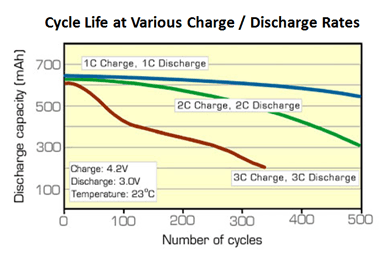
The cycle life for eg is quoted typically at 2000 at 80% discharge. But that is usually quoted at at low 0.1C discharge rate. At higher discharge rates, (or charge rates) you get less cycles. Sometimes a LOT less. Lithiums like gentle use even if they are capable of huge currents. So it pays to be sure we are as far from the max continuous C rate as possible. To do this it pays to use:
-Highest rate cells you can find if weight or size isnt an issue (low rate are typically more energy dense and lighter)
-Largest capacity pack you can get in the space available. Since more capacity = less Amps draw per cell.
Theres no "cut off point" or max figure here like a fuse or trip. Lower compared to C rate, is always better. Its up to the system designer to match capacity, C rate, cost, size, weight, cycle life expected, charge voltages, capacity used per cycle, etc etc.
The MAX C Rate (pulse) means very short term discharge up to about a second or two that wont instantly ruin the cell. Heat isnt an issue here, pulse is too short, its just internal construction. So you can start an engine. That takes just 1 secont to 2 seconds typically. But driving a powerchair at high Amps up a hill is a no no...
Continuous C rate means more than say a second or two secs, up to indefinitely, that will not cause failure. (driving your powerchair up a hill). It will drastically shorten service life and get very hot via internal resistance. Heat, even a few degrees shortens service life rapidly. I keep my hobby packs in the fridge. This is one reason that cylindrical metal cells have higher continuous ratings. More surface area to lose heat and gaps between cells even if pulse or int resistance is the same.
So here for eg you take a 100Ah cell that is 1C cont you CAN take 10A from it without overheat or damage. But its cycle life will be worse than lead. Remember that a powerchair with 120A controller can pull 240A for at least 10 seconds at a time, and 60 or 100 Amps+ as you climb a steep ramp. A 3C cell is 300A capable. But a 5C one is much further from its C rate limit and will last longer.
Resistance is another thing. This results in voltage drop under load. And is another reason some higher resistance cells are low C rated. Because this resistance heats them up. And because the resistance reduces output under load.
Lithium likes to be cool. But dont charge below freezing. (low C use, or high C cells, or large pack or preferably all 3)
Likes to go nowhere near its top or bottom voltage. (NO bms!!!, and large pack charged accurately to a slightly lower voltage)
Likes low current (charge and discharge).
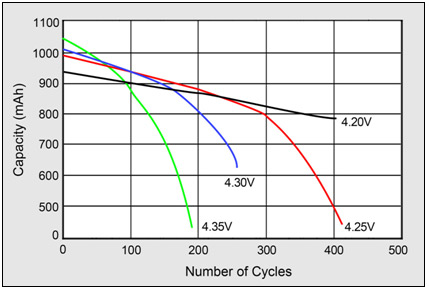
Heres an ex of lipo with 3 different discharge rates and cycle life:
Affect of charge voltage on lipo/lithium ion
Interesting page on lithium batteries but it ignores LiFePO4 as it really relates to consumer batt like laptops. But apart from voltage difference, much of the same applies.
http://batteryuniversity.com/learn/arti ... _batteries
C rate refers to a bunch of things. Not just voltage drop under load. Its a guide to allow you to fingd the best cell for a job.
The cycle life for eg is quoted typically at 2000 at 80% discharge. But that is usually quoted at at low 0.1C discharge rate. At higher discharge rates, (or charge rates) you get less cycles. Sometimes a LOT less. Lithiums like gentle use even if they are capable of huge currents. So it pays to be sure we are as far from the max continuous C rate as possible. To do this it pays to use:
-Highest rate cells you can find if weight or size isnt an issue (low rate are typically more energy dense and lighter)
-Largest capacity pack you can get in the space available. Since more capacity = less Amps draw per cell.
Theres no "cut off point" or max figure here like a fuse or trip. Lower compared to C rate, is always better. Its up to the system designer to match capacity, C rate, cost, size, weight, cycle life expected, charge voltages, capacity used per cycle, etc etc.
The MAX C Rate (pulse) means very short term discharge up to about a second or two that wont instantly ruin the cell. Heat isnt an issue here, pulse is too short, its just internal construction. So you can start an engine. That takes just 1 secont to 2 seconds typically. But driving a powerchair at high Amps up a hill is a no no...
Continuous C rate means more than say a second or two secs, up to indefinitely, that will not cause failure. (driving your powerchair up a hill). It will drastically shorten service life and get very hot via internal resistance. Heat, even a few degrees shortens service life rapidly. I keep my hobby packs in the fridge. This is one reason that cylindrical metal cells have higher continuous ratings. More surface area to lose heat and gaps between cells even if pulse or int resistance is the same.
So here for eg you take a 100Ah cell that is 1C cont you CAN take 10A from it without overheat or damage. But its cycle life will be worse than lead. Remember that a powerchair with 120A controller can pull 240A for at least 10 seconds at a time, and 60 or 100 Amps+ as you climb a steep ramp. A 3C cell is 300A capable. But a 5C one is much further from its C rate limit and will last longer.
Resistance is another thing. This results in voltage drop under load. And is another reason some higher resistance cells are low C rated. Because this resistance heats them up. And because the resistance reduces output under load.
Lithium likes to be cool. But dont charge below freezing. (low C use, or high C cells, or large pack or preferably all 3)
Likes to go nowhere near its top or bottom voltage. (NO bms!!!, and large pack charged accurately to a slightly lower voltage)
Likes low current (charge and discharge).
Heres an ex of lipo with 3 different discharge rates and cycle life:
Affect of charge voltage on lipo/lithium ion
Interesting page on lithium batteries but it ignores LiFePO4 as it really relates to consumer batt like laptops. But apart from voltage difference, much of the same applies.
http://batteryuniversity.com/learn/arti ... _batteries
-
Burgerman - Site Admin
- Posts: 71096
- Joined: 27 May 2008, 21:24
- Location: United Kingdom
Re: Step by step lithium conversion?
by Scollard » 25 Apr 2016, 21:46
After my Full Lithium conversion I got myself a Trilift Scooter carrier. Big upgrade from my Tilt-a-Rack. Fully electric, no straps, it lock itself in securely.
- Scollard
- Posts: 258
- Joined: 29 Aug 2015, 01:43
- Location: Seattle, WA
Re: Step by step lithium conversion?
by expresso » 26 Apr 2016, 03:07
nice - thats a huge scooter - alot of room -
Quickie 636 - 230ah LifePo4
- expresso
- Posts: 11985
- Joined: 10 May 2010, 03:17
Re: Step by step lithium conversion?
by JoJo7 » 01 May 2016, 20:29
Some questions for Burgerman regarding lithium iron phosphate batteries:
1) am I correct that, during driving, you do not limit the C discharge rate of your batteries other than by having a large enough capacity to handle the maximum current drawn by your controller?
2) How do you estimate the remaining capacity/(mileage) available?
3) how do you avoid over discharging, and therefore ruining, your batteries?
4) roughly how much charge (as a percentage) do you have left when your cells drop to 3.0V?
5) how much more charge (as a percentage) do you have left before the cells will drop to 2.5V? (Which I understand is the level that will damage cells)
Regards,
Joe
PS you're probably getting tired of answering some of these questions but there's a lot of new material to learn regarding lithium batteries.
1) am I correct that, during driving, you do not limit the C discharge rate of your batteries other than by having a large enough capacity to handle the maximum current drawn by your controller?
2) How do you estimate the remaining capacity/(mileage) available?
3) how do you avoid over discharging, and therefore ruining, your batteries?
4) roughly how much charge (as a percentage) do you have left when your cells drop to 3.0V?
5) how much more charge (as a percentage) do you have left before the cells will drop to 2.5V? (Which I understand is the level that will damage cells)
Regards,
Joe
PS you're probably getting tired of answering some of these questions but there's a lot of new material to learn regarding lithium batteries.
- JoJo7
- Posts: 388
- Joined: 31 Mar 2011, 00:23
- Location: San Francisco Bay area, California, USA
Re: Step by step lithium conversion?
by Burgerman » 01 May 2016, 20:42
1) am I correct that, during driving, you do not limit the C discharge rate of your batteries other than by having a large enough capacity to handle the maximum current drawn by your controller?
Yes, and your controller limits current to a fixed max value. Unlike ebikes or hobby stuff so its easy to do. Best to be 2 or 3 times away from the cont limit for long life.
2) How do you estimate the remaining capacity/(mileage) available?
You cant. Unless you measure Ah or Watt hour used. You can only really tell reliably when its about 98 percent over based on volts...
3) how do you avoid over discharging, and therefore ruining, your batteries?
Fit BIG btteries. Then you wear out long before they do. This also means low average discharge level, and it keeps them further away from the C rating too, both of which mean longer life. If you must run them low, stop driving when voltage begins to fall below 3V UNLOADED. At this point theres about half a mile left and it will start to drop like a stone.
4) roughly how much charge (as a percentage) do you have left when your cells drop to 3.0V?
Not much worth mentioning!
5) how much more charge (as a percentage) do you have left before the cells will drop to 2.5V? (Which I understand is the level that will damage cells)
About 2 or 3 percent. And 2.5 wont damage cells. But if you go below 3 then SOME cells may be below that unless you monitor individually. Lowest before damage is 2v. Which happens about 3 feet later!
Yes, and your controller limits current to a fixed max value. Unlike ebikes or hobby stuff so its easy to do. Best to be 2 or 3 times away from the cont limit for long life.
2) How do you estimate the remaining capacity/(mileage) available?
You cant. Unless you measure Ah or Watt hour used. You can only really tell reliably when its about 98 percent over based on volts...
3) how do you avoid over discharging, and therefore ruining, your batteries?
Fit BIG btteries. Then you wear out long before they do. This also means low average discharge level, and it keeps them further away from the C rating too, both of which mean longer life. If you must run them low, stop driving when voltage begins to fall below 3V UNLOADED. At this point theres about half a mile left and it will start to drop like a stone.
4) roughly how much charge (as a percentage) do you have left when your cells drop to 3.0V?
Not much worth mentioning!
5) how much more charge (as a percentage) do you have left before the cells will drop to 2.5V? (Which I understand is the level that will damage cells)
About 2 or 3 percent. And 2.5 wont damage cells. But if you go below 3 then SOME cells may be below that unless you monitor individually. Lowest before damage is 2v. Which happens about 3 feet later!
-
Burgerman - Site Admin
- Posts: 71096
- Joined: 27 May 2008, 21:24
- Location: United Kingdom
Re: Step by step lithium conversion?
by JoJo7 » 02 May 2016, 00:06
Thanks for the response. Things are getting clearer all the time.
A few messages back Burgerman said:
According to my calculations it most definitely DOES matter. I did some modeling based on lead and lithium discharge characteristics and it appears that if you just hook a supplemental lithium battery in parallel with your lead batteries and don't control the lithium discharge rate somehow, the lithium battery will discharge almost completely before the lead batteries start contributing significantly to the current drawn. This means, for example, if you have something like a 74Ahr lead battery in parallel to a 30Ahr lithium iron phosphate battery addon and a 100A controller the lithium battery will discharge at rates as high as ~7C (= 200A/30Ahr).
Regards,
Joe
A few messages back Burgerman said:
Prismatics generally have too low C rating compared to cylindrical cells. So suffer more at a given Amp level and so are less likely to live as long. And voltage drop under load will likely be greater too. Does it matter on an addon? Probably, as the lithium voltage is higher than the lead most of the time and so more is taken out of the lithium at times of heavy load. But both will work.
According to my calculations it most definitely DOES matter. I did some modeling based on lead and lithium discharge characteristics and it appears that if you just hook a supplemental lithium battery in parallel with your lead batteries and don't control the lithium discharge rate somehow, the lithium battery will discharge almost completely before the lead batteries start contributing significantly to the current drawn. This means, for example, if you have something like a 74Ahr lead battery in parallel to a 30Ahr lithium iron phosphate battery addon and a 100A controller the lithium battery will discharge at rates as high as ~7C (= 200A/30Ahr).
Regards,
Joe
- JoJo7
- Posts: 388
- Joined: 31 Mar 2011, 00:23
- Location: San Francisco Bay area, California, USA
Re: Step by step lithium conversion?
by Burgerman » 02 May 2016, 01:55
Except that what you miss is that on a 100A controller, then the MOTORS may draw 100A at low speed or when stalled quite often. But that 100A typically happens at say a 50% to 70% pulsewidth approximating 12 to 14 volts...
So 2x 100 motor Amps is only 100 to 120A total at the battery cables. And also as you load the lithium, the cable resistance and internal lithium resistance also means that at least a part of this current comes from the lead battery as the voltage drops under load. And the greater the current the more this happens. Which is later replaced back into the lead by the nominally higher voltage lithium.
So while the headways are a better bet, the prismatics will also work. But wouldnt be my choice.
So 2x 100 motor Amps is only 100 to 120A total at the battery cables. And also as you load the lithium, the cable resistance and internal lithium resistance also means that at least a part of this current comes from the lead battery as the voltage drops under load. And the greater the current the more this happens. Which is later replaced back into the lead by the nominally higher voltage lithium.
So while the headways are a better bet, the prismatics will also work. But wouldnt be my choice.
-
Burgerman - Site Admin
- Posts: 71096
- Joined: 27 May 2008, 21:24
- Location: United Kingdom
Re: Step by step lithium conversion?
by shirley_hkg » 02 May 2016, 08:58
Burgerman wrote:
[b]3) how do you avoid over discharging, and therefore ruining, your batteries?
Fit BIG btteries. Then you wear out long before they do. This also means low average discharge level, and it keeps them further away from the C rating too, both of which mean longer life. If you must run them low, stop driving when voltage begins to fall below 3V UNLOADED. At this point theres about half a mile left and it will start to drop like a stone.
!
You can use cell monitor , with an ON / OFF switch at its 0V pin , to keep clsose look at cell voltages .
You turn it ON when necessary , say overall voltage of a 8S system drops below 25V . You don't always go that low , do you ?
On the other hand , if you are recharging batt ... EVERYDAY ... WITH HOBBY CHARGER LIKE PL8 , you can leave it ON all the time because these chargers have bigger balance power which is capable of overcoming the 200mah daily partial discharge .
- shirley_hkg
- Posts: 4656
- Joined: 31 Dec 2010, 13:42
Return to Everything Powerchair
Who is online
Users browsing this forum: emilevirus, Juggler258, Seafighter, Superchunk and 485 guests
