|
WheelchairDriver |
|
||
 |
| ||
|
WheelchairDriver |
|
||
|
|
| ||
|
|
||||||
|
IMPORTANT STUFF Must read 1: This battery is SAFER than your old Lead bricks. It doesn't burn or give off explosive gasses if overcharged like your old lead ones. It doesn't burn if punctured... It is the *ONLY* Lithium based battery chemistry as of 2015 that is safe, and can fitted completely safely into a powerchair. You need not worry. Must read 2: There are NO lead brick, plug & play, dumb replacement lithium batteries that will work properly, or that will be any good used in a powerchair for many complex reasons. Don't waste your time looking. I know a thing or two about batteries! There are no easy "plug & play" DIY type systems
either that
use a BMS that are any good. At least non that will last or offer the
true benefits that are possible from lithium. Don't waste your time looking. And pretty much ignore
all that the battery suppliers and other "experts" that will sell you
these things will tell you. Why BMS setups kill
lithium cells You have hypothetical powerchair motor and 100A controller with a 24v battery. At "stall" when you are trying to climb a curb or driven into a wall for e.g. it draws the controllers maximum 100Amps at full throttle "stick". This will be lets say say at 12 motor Volts or a 50% pulse-width delivered from the controller. The controller throttles back to never exceed its 100A rating. And this is the most torque you can ever have. For reasons that are complex, the BATTERY amps at this 100 Motor amps, will be exactly HALF of this at 50Amps when pulse-width = 50%. The same total power at motor, and battery but at 2 different Voltages. (same total Watts). Now if we do the thing same again, but reconfigure the same size and weight of battery, but now at 48 Volts, we get the following: Same 100A motor Amps at stall at the same 12v at the motor. But now its at just a 25% pulse width. But now battery Amps are HALF the above. So 25Amps. Same total watts again as the previous example. We don't gain any range though because the battery CAPACITY is also now just half of the 24V one. (Same weight, same Watt/Hour capacity) But because of the higher voltage, we can go on to DOUBLE the speed! This is all perfectly true and it means you "win" double the speed for free! Because of Peukert and internal resistance this wont work well with lead based batteries however. But its ridiculous not to do this with Lithium since a correctly configured system ALLOWS this to happen. You would be throwing away half of the massive advantages that these batteries allow not to do this. Conversely, you COULD alternatively fit a smaller capacity battery, shorter slower gearing, use a higher voltage to recover the same mph speed back, and lose no range. This would be great for a portable chair. Both methods are valid. Either way 24V batteries miss out on these goodies! Any manufacturer that simply fits Lithium 24v battery in place of 24V Lead battery or that offers the option, has totally missed the point! And that's quite likely exactly what will happen once they wake up. And they will miss out on half of the advantages lithium batteries can provide. But even that would be (or could be if it was implemented correctly) a huge range and service life improvement over what they provide now.
BATTERY SIZE! Lithium battery size really matters. A lot! Bear with me. A full sized Group 24 powerchair battery, as used in the biggest Hi-End powerchairs, starts off its life with a claimed 70Ah approx. Only it does NOT! That figure refers to a 100 percent discharge battery (that rapidly destroys it in a few cycles in a week) and so we are only supposed to discharge it to a max of 80% discharged to get 300 to 450 cycles. A year? So now your heavy 70Ah Lead battery is really just a 55Ah battery. That's right, that's all we are allowed to use. That's all that we can use. But wait. Its not even 55Ah! Because that measurement refers to a smooth constant slow 20 hour discharge rate. There's another affect called the Peukert affect. Look it up. The faster we discharge it the smaller the battery is... We typically take power from a powerchair in short violent high rate bursts at up to 240Amps maximum at a time with a 120Amp controller in a high end powerchair. Up to 120A per motor. And longer periods of lower currents. Even if we were super generous, and reduced that by some TEN TIMES and call that just 24 Amp bursts (its much more in reality!) than that's really the '3 Hour' rate. Used hard, you can discharge a powerchair in 3 hours of continuous travel. A typical lead battery will deliver just 55 to 60% of its power over a 3 hour period. So you only really get 1/2 to 2/3rds of that remaining 55Ah... Then you just stop. Lets be kind again, call it 50 percent of the 70Ah you started with, that is actually available for use before you stop. Its not actually that good in reality. This gives us: Typical 2x Group 24 batteries are storing 24V X 35Ah = 840 Watt/Hours of USABLE & accessible energy. The Lithium battery I am using, has every last bit of that 45V & 72Ah available for use. There is ZERO Peukert affect with a LiFePO4 battery and it can have all of its capacity utilised safely. So the Lithium Battery pack I am using has 45V x 72Ah = 3,250 Watt/Hours of USABLE energy. Or approx 3.9 times as much stored energy as a set of Group 24 Lead / Gel / AGM deep cycle. Really!
WHY DO WE NEED A LITHIUM BATTERY 3+ TIMES AS BIG AS A NORMAL POWERCHAIR 'LEAD' BATTERY? Because there are many HUGE advantages to Lithium battery technology, but: >>> ONLY IF IMPLEMENTED CORRECTLY!!!
<<< 1. HUGE 10 to 20 YEARS SERVICE LIFE. Fit and forget them. They can easily OUTLIVE the powerchair. IF IMPLEMENTED CORRECTLY. Or be no better than lead if not. Lithium batteries don't reward a hard life. They hate high current draw. This seriously shortens service life. Hence using the HIGH C RATE HEADWAY CELLS! And then use the actual power in amps at a very much lower rate instead. To give them a nice easy life. A bigger Ah pack allows this. They live longer with a lower Amp (lower current draw) being taken from them on average, if the battery is bigger! Big capacity = good here. They also live much longer with less average depth of discharge. And again the bigger the pack Ah is, the lower the average discharge level. Fitting bigger capacity battery (larger storage in Watt/Hours) instead of the old small Lead battery, means that both these ideals are realised. Low DISCHARGE LEVEL, and low AMP DRAW per cell. And its easy to do this too! Since lithium is both MORE ENERGY DENSE allowing you to fit a lot more Ah in a given space, and is lighter as well. NEVER just fit 70Ah of Lithium battery to replace the same old 70Ah of Lead battery for e.g. Because the Lithium battery service life will be drastically reduced and may well be no better than the old lead battery we used to use. So again BIG capacity = good here. Treated gently (by using much larger Lithium battery capacity) we expect to get greater than 2000 full discharge cycles. And 10's of thousands of partial cycles. Rather than the much lower figure expected if the battery was the same size as the lead battery you replaced. Plus you would also miss out on other huge benefits that lithium allows such as: 2. HUGE RANGE. The BM3 chair has around 3x (actually more) of the range of a normal high end powerchair, even with its much higher top speed capability. Not because "it uses a lithium battery". That is just marketing bull. But because it uses a MASSIVE correctly implemented Lithium battery. Because lithium is much more compact and energy dense and also lighter, it allows us to cram in a much bigger amount of electrical storage capability into the same old battery space and still save around 50lb in weight. This is one of the main advantages of using Lithium. So always get as much Lithium battery storage into the chair as humanly possible! You are aiming to get almost double the Ah or Watt Hours in there compared to Lead. Or you failed. In the BM3 powerchairs case this is more difficult to calculate. Because the voltage is also increased to almost double at the same time. But we do this simply by converting it to Watt/Hours. The battery in the BM3 has well over 3x the electricity storage capability of a set of Group 24 batteries as used in a high end powerchair. Or 3,240 Watt/Hours USABLE! Some 3.9 times better than a Lead powered wheelchair. That's is a simply HUGE gain.
3. CYCLE LIFE. Another huge advantage of correctly implementing a Lithium LiFePO4 battery is it's cycle life. It has by far the best lifespan of all lithium batteries, and approx 5x better than lead batteries. But this doesn't tell the full story. Because a Lead battery (or a small lithium battery) needs charging daily, then your 300 to 450 expected service life cycles are over in approx 1 year if you use the chair reasonably hard. A small lithium pack will not last much longer than a lead battery since its overworked. If however you do it properly, and don't overtax your huge oversized lithium battery, you will see the full 2000 cycles of service life from it that it is truly capable of. Or its expected 20 year shelf life. Whichever comes first. Or better, since you now have no need to discharge it so deeply and so should really get 5 or 10 thousand cycles! Or because you may only need to charge it maybe twice a week if you are a heavy user. This means your 2000 cycles = 1,000 weeks. Or some 19.2 YEARS!!! Seriously. Even then it will still have double the range remaining of one of today's lead powered chairs still left in it! 4. NO BMS! The best way to ruin a battery fast. And to have fires, balance problems and reliability issues. So non is used! Or required. Or wanted... In a PROPERLY implemented system non is required. See Why BMS setups kill lithium cells The job that the BMS would normally do extremely badly is taken care of by the power controllers programming, and by using cells that are far more than capable of supplying a larger current than we will ever pull from the battery. The charging is better taken care of with a superior cell balancing charger that is accurate to 0.003v per cell, and never allows any cell to exceed 3.600 Volts ever. The low voltage limit is taken care of progressively by the chairs controller. No BMS required. Lithium isn't a battery its a part of a thought out system.
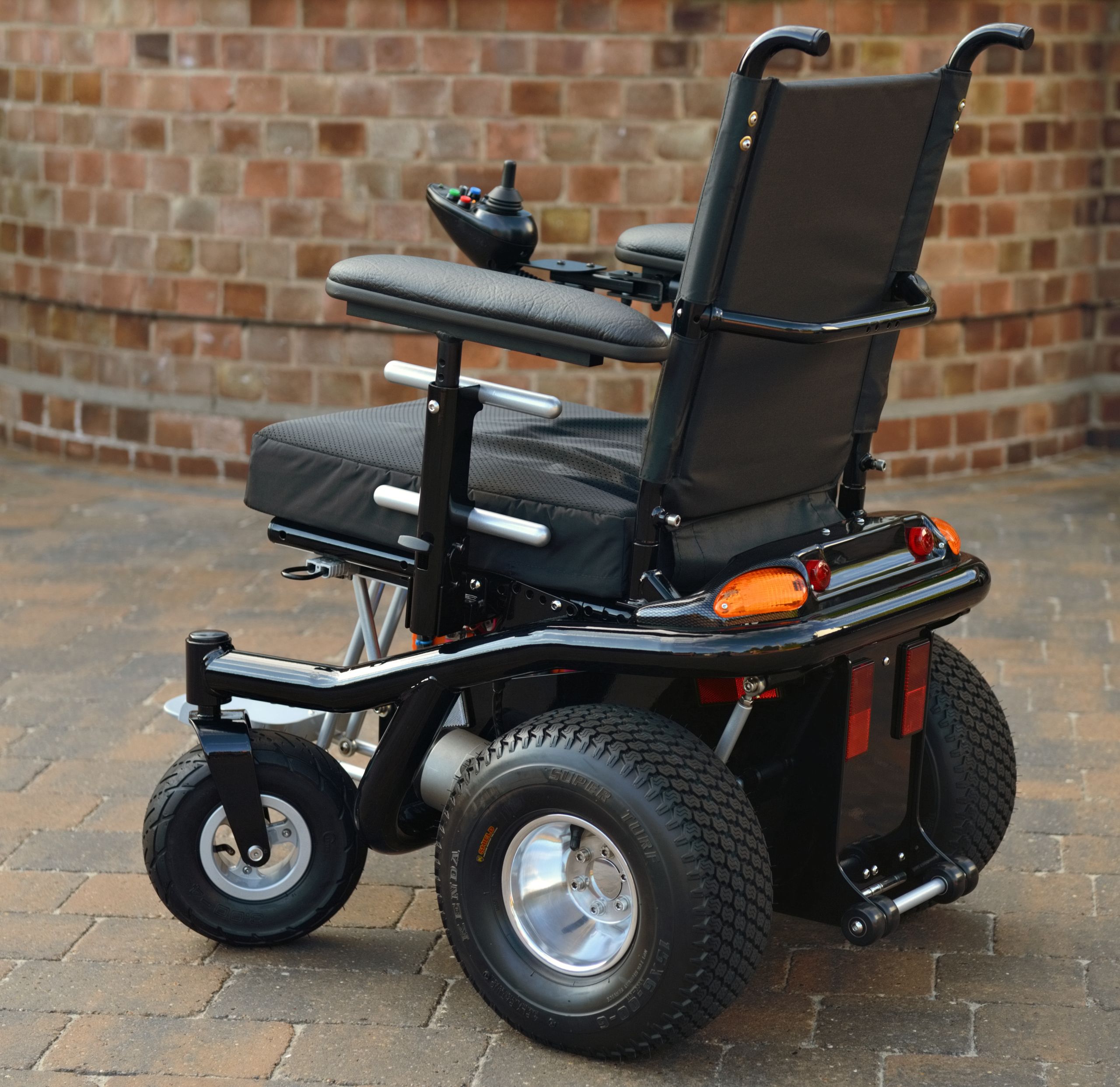
A POWERCHAIR IS DESIGNED AROUND ITS BATTERIES, SINCE THEY ARE IT'S WEAKEST LINK A POWER Wheelchairs maximum speed, its level of torque and control, its range, and its physical external dimensions and its weight are all limited to, and totally determined by its batteries. They are the weakest link in ALL powerchairs & electric vehicles. Its all a balance here. More of one means less of another. Width, ground clearance, seat height, weight, range, speed, are all in a competing area and are all fighting for space and are each in one compromise or another. Lead batteries as used by almost every powerchair manufacturer today are frankly hopeless! As of 2011, I am now only building Lithium battery powered wheelchairs for my own personal use. Non of the real manufacturers do this yet, because they plainly do not "get it". Lead is DEAD, They should move on! (ADDED: And its now 2015 and would you believe all mainstream chairs are still using the same old antiquated retarded lead bricks!!!)
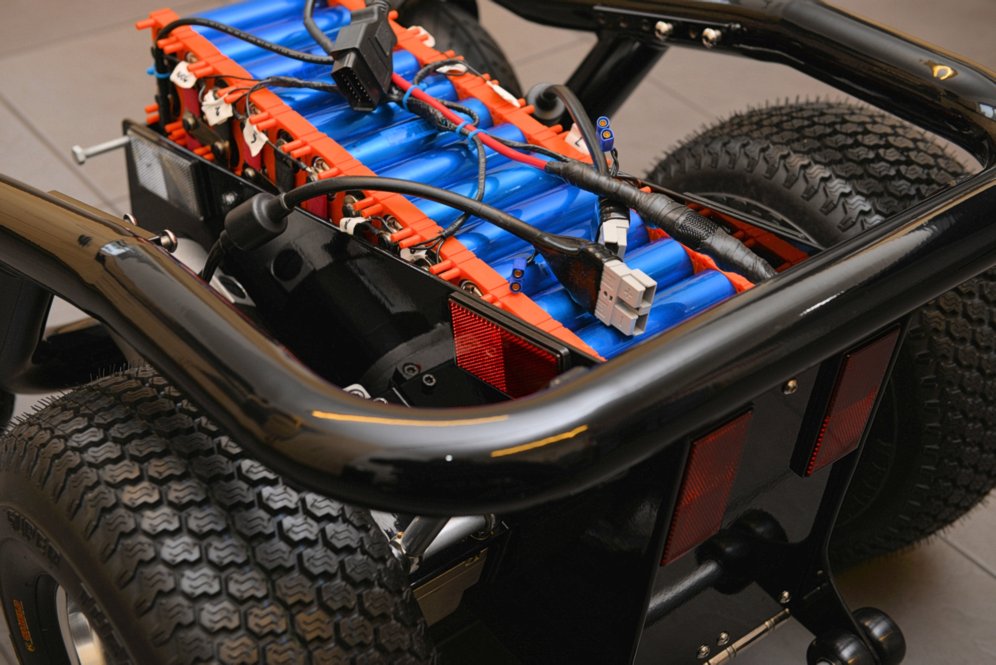
THIS IS A PROTOTYPE/ONE OFF CUSTOM POWERCHAIR BUILT FOR ME, BY ME! SO IT TAKES MANY DIFFERENT TYPES OF BATTERIES PROPERLY BY DESIGN... This shows a 3240Watt Hour Lithium in comparison for size with a pair of typical 840Watt hour (combined!) group 24 batteries as used in a HI END powerchair. The lithium battery is the exact same 520mm length. The same width at exactly 171mm. That centre section is 2mm bigger in width than all of the battery options. The lithium is however just 14mm taller than the terminals on the lead group 24 batteries here. Total height 240mm. At least when using a 6 cell tall battery. Nothing stops you using a 5 cell tall one though at which point its 200mm tall. There is usually an extra 14mm to spare anyway, as it makes sure there in nothing touching the usual lead battery connection terminals for safety. So the 6 cell tall battery normally fits anywhere a group 24 battery can. I designed my powerchairs centre section/battery area (shown here unfinished), to accept either 78 Lithium cells like these Headway cell batteries, or two group 24 old style Gel/AGM batteries, or 3 Odyssey PC1200 batteries for 36v lead should I want to test that option. All are the same size physically. All fit neatly.
My new BM3 (MK 3) powerchairs centre section, with a pair of group 24 batteries for comparison. Note terminal height and required clearance. And the very snug fit!
Same centre section, but with 3x the energy, 2x the Volts and 52 lb lighter! Note battery is 14mm taller than the group 24 battery terminals. But no clearance required so not a problem.
I charge these with a special Lithium Charger and use no BMS!!!
My LITHIUM battery (built from single Headway 12Ah cells as shown above) have the following specification:
SUMMARY 1. They have another advantage too. They sit in the shelf in my torch/RC transmitter for a year with about 5 percent or less loss of power! 2. They do not sulphate and die if left unattended or discharged for a few weeks like Lead. 3. They are the SAME price Ah for Ah as premium deep cycle batteries TODAY. 4. And give MORE RANGE Ah per Ah because they suffer no Peukert effect. 5. GOOD high C rate cells have much better high current capability meaning more torque, and smaller lighter batteries. 6. They last 4 to 5 times as long in cycle life, and at least 3x longer in shelf life. 7. 2x the Ah can fit in the same space giving 3x the range... (Peukert!) So really are physically 3x smaller! 8. They are 5x lighter Ah per Ah... That's not a typo. 9. They are SAFE as long as we are talking about LiFePO4 as I am using correctly integrated, not a BMS!!! 10. And the real kicker! They are hugely cheaper right now than inferior lead batteries as they will last the life of the chair (at least if correctly sized and charged) 11. And because the high C ratings allow bigger currents from a smaller capacity battery it also allows higher voltage packs to be used which means "free" extra speed through greater efficiency using the controller as an efficient gearbox.
RANGE / POWER CALCULATION SPREADSHEET
Range spreadsheet 1. Shows that the motors are within their rated watts limit so will not overheat at a
continuous 15+ mph.
BURGERMAN >> BM3 Home Here! << |
|
PDF summary/print | Caster flutter pre-fix test vid@12mph | RC Brake test video | Folder/images
|
|
|