What
actually goes wrong with our powerchairs?
Detailed PowerChair Only Menu
In "normal" use usually very little
does.
If you use and abuse your powerchair or it is modified and
reprogrammed as mine and many others are for sport/basketball so as to regularly access its maximum amp rating
and acceleration or if used
very hard there are a few things that fail
quite regularly...
At least on mine and my friends and other web site readers chairs. I fix
and repair and modify powerchairs for others that are not the "average" users. As
such I see more of the things that fail than your average "proper"
dealer!
Everyone I know seems to be very active and break stuff.
Most modern powerchairs are reliable as seen
by the manufacturers and most users.
Because most power wheelchair users
are the type of people that don't push the limits or don't
really "use" their equipment hard.
Most users typically don't go out in freezing salty
winter roads, don't go off-road everyday walking the dog on steep slopes
and into the woods. Don't go everywhere absolutely flat out, don't jump off
curbs without slowing down etc. These things test their powerchairs literally to destruction. If ALL
users were like this they would be built better or there would be an awful lot
of warranty claims.
Many people don't do any real distance
daily either. The fact that they get more than 12 months from a set of batteries
tells me that much!
And when I look at the timer / mileage on many other peoples
powerchairs (in its software) its typically 20x less than my own even on 10 year
old powerchairs. Most powered wheelchairs have an easy life sat in front of a computer or
sat in some old peoples home and are hardly "used" as such. Things not "used"
don't fail... That's about 95 percent of powerchairs. This page is for the
other 5 percent!
I have bought several powerchairs that were 10 years old and
basically "as new" when stripped down apart from a few minor scratches and some
dust and muck. My F55 very modified wheelchairs and a
good few of the sort of people reading this page don't have this luxury! I
actually USE mine very hard and they fail, corrode and give up after a year or eighteen
months. Now I build
them myself as well as humanly possible to avoid all the usual problems.
As I am sat here right now in my powerchair, and its covered in salt and
crud from the wet winter roads as I just got into the house. Its motors are very
hot, I just "walked" my dog off road in winter and did about 7 or 8 miles. Its batteries are very discharged. As they are every day by 7pm
in the evening...
I have also been into town shopping and paying bills and out
flying model planes (helicopters today) on an airfield. They are
(batteries) currently on a one hour fast charge
to allow me to go back out in an hour into the town for beer or three! That
involves getting up and down curbs by wheelieing, and crashing the rear wheels
up or down 4 inch or bigger curbs due to the world we live in. No curb cuts. And a further
rough 5 miles each way. I do this or much worse daily.
I will be back about 2am As I am every
night (morning!). The point is that my usage is abnormally high and difficult and I am fat! And I am
active. I spend all day leaping off curbs, going over bad ground, I never slow
down. I don't just
drive about carefully in smooth dry flat shopping centres like the average user.
This page is concerned (mostly) with
the faults that can leave you stranded and unable to get home since they are the
important ones! All the rest are just a minor technicality...
And as
usual I have just noticed a new fault as I do every few months
Its making an odd noise. *Again* Under
load/acceleration on the left side. I know what that sound is because I have
heard it all before. This following section applies to the Sunrise
F55s powerchair latest 4 pole motor. (EMD) But even if your powerchair is
a different model or manufacturer the same principles still apply. Motor couplings and cush drives are a
common failing in many heavily used powerchairs. Its a good idea to know what
state yours are in if you are a hooligan like me Before they let you down!
If you are 1 of the 95 percent of average users then don't worry it will be like
new. But its
good to check and know as much as possible about your powerchair if you depend
on it to get you home.
|
|
Motor "Connectors"
or Couplings or Cush
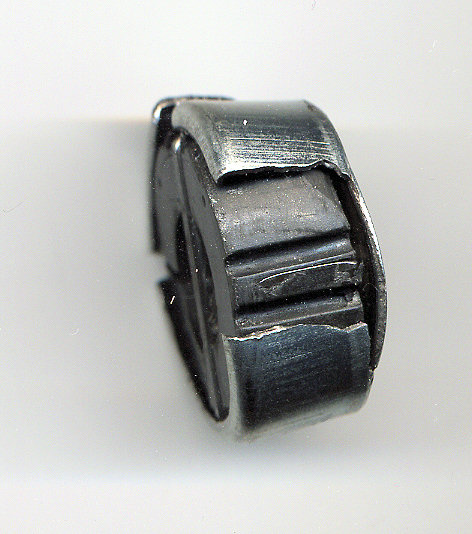
Drive Rubbers (call them what you wish) have failed again. Or are
about to dp. It starts as a slight scraping sound.
Then they jam solid when you have decided the sound is nothing serious sometime
in the next few days. This is a small component that goes between the motor and
the gearbox.
It connects the drive from the motor to the
gearbox with a but of rubber to smooth and quieten the drive system. It ads a
small "cushion". And in both the 2 pole motors fitted to early chairs and the 4
pole ones fitted to later Sunrise F55 Power Wheelchairs this fails with hard
regular use. Not just on my own powerchairs but on at least 2 others that I have bought
on eBay. All were still working but were damaged when inspected. Some are in the
pile below...
And you get stranded wherever you happen to be!
The thing is when this does happen on the latest 4 Pole motors as fitted to my
wheelchairs
it jams them up completely.. |
 The
freewheel lever does not help here on many powerchairs and doesn't on the F55.
You cannot be pushed. If it happened while
crossing a busy junction you would be really screwed... The
freewheel lever does not help here on many powerchairs and doesn't on the F55.
You cannot be pushed. If it happened while
crossing a busy junction you would be really screwed...
So far that hasn't happened. Fortunately it
failed at home and once close to home and both times the powerchair was
immovable. All the other times I recognised a
strange noise and fixed the problem before it failed completely. My ears are
getting highly tuned!
But imagine what would happen if this happened in a strange
town leaving you unable to get back into your vehicle or on to a train/taxi.
Most people will probably never get this fault, as its caused
by the sudden acceleration or increase in the amount of "torque" or power that
the motor transmits to the gearbox caused by the rather sudden starting jolts
that my modified power wheelchair displays rather well because of its
programming and bigger controller than stock. But at least some do evidenced by the powerchairs I bought on eBay.
Contrary to what you may read on a certain other websites its quite possible
to reprogram your powerchair, not to give not more "peak" amps than your
controller size allows but to get more easily accessible amps by reducing all
the smoothing and delays programmed in everywhere and correcting the motor
compensation settings.
You get
more power to the wheels for more of the time and more often. Especially at low speeds and
while setting off. Some of the failed cush drives were from a friend that plays
wheelchair basketball a lot. He kills them as well. The greater the average time you can actually
access your 80 or100 amps or whatever your controller provides the greater the
problems it may cause if the cush drive rubber cant quite handle it.
It means
your 100 amp (or whatever size you have) controller actually gets to deliver
that 100 to each motor way more often! The way some (almost all) powerchairs are programmed from new, the only
time that they can ever see a full 100 amps is when the motor is stalled on a
steep ramp or against a wall. And with
some of the higher impedance motors used even that will not draw the full possible
controller current.
See below... I don't much care that my settings are
causing this damage, because its not the settings that are wrong but the
couplings that are weak! The sluggish stock setting just serve to hide it
most of the time. And its not just me and its not just AMD motors.

Above: Is a half a dozen destroyed Cush Drive
Rubber Couplings. They fail very suddenly and jam your motors rock solid. Nobody
can push you or it home. Great huh? And to all those that say powerchair motors
are reliable -- these all came from my power wheelchair in the last three years.
I actually have another pile that came from friends and eBay powerchairs as
well. I have some older ones of a different type that failed too. This happens on most
makes of powerchairs, as many others that email me testify, if you actually
use it hard. If you spend all day at your desk, drive carefully
and have stock programming then don't worry you are safe! Hopefully.
Separate replacement parts (motor couplings) are not available and you have to buy a new set of motors! Great.
And they wonder why we get frustrated as "users". If you are not sat still in an
old peoples home then you must be "abusing" the powerchairs...
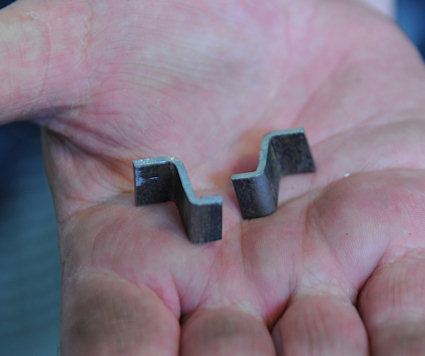 The
permanent cure in this one case The
permanent cure in this one case
Opposite is two simple bent steel plates. They go in the same spot that you
just removed your weak disintegrated rubber cush drive coupling from.
They are simply cut from 2.3mm steel sheet. And filed carefully to shape. (2mm sheet is
probably ok at a push
but it may rattle/squeak/have a tiny bit of free play) 10.5 mm deep x
28mm long. Simply bent in a vice to leave a flat 12mm section in the centre and
Z shaped ends as you can see... Low technology. You gotta luv it.
Its a touch noisier mind but you have to really listen. Better noise than failure!
These do not have the rubber bit of course but I really cannot detect any difference at all in use apart from being very slightly noisier on "cruise"
at times. And it no longer fails which is the most important part.
I fit these as a matter of course to all my new motors and powerchairs from
new now. And I get through quite a few motors! Scroll down.
(update. I now "Fix" the motor couplings by adding a tight fitting steel tube
to the outside before they fail. So they cannot expand and split. I do this in a
vice and use some exhaust pipe tubing cut to size)
They fit in between the motor and the gearbox casing. It comes apart at the
join with 4 6mm Allen head (cap head) bolts.
 At
which point you will see (this image) the slot cut in the end of the
gearbox shaft (the motor shaft is the same). At
which point you will see (this image) the slot cut in the end of the
gearbox shaft (the motor shaft is the same).
You can see my bit of bent steel blurred sat on the casing here. And the slot
in the end of the shaft. You will need to pull the old wrecked cush drive off first
of course.
Check it for splits and cracks. see image later! If found fit the bit of bent
metal instead as shown in the next image and away you go about 600 UK Pounds
better off.

With the Z shaped steel plate fitted ready to bolt the motor back on to the
gearbox. You may need to tap it in with something as its a tight push fit.
At least mine all were.
To make sure that the motor and gearbox shafts are absolutely inline its best
to run the motor from a battery with the 4 bolts loose and tighten them while it
is running. Although I gave up bothering as they seem fine anyway.
|
|
|
The reason it jams is
that the rubber bulges out under load and hits the casing. And the missing metal
part also jams things up.
These are EMD 4 pole motors supplied
by Sunrise Medical as fitted to my F55 powerchair.
The older two pole motors also have a cush drive that fails,
and it looks nothing like this one!
For what its worth I have seen many other
makes fail in the same / similar way too. So its not all their fault! Some of its mine... If you have a lot of backlash or funny noises or
clunking when turning left/right this could be your problem. Check it out! |
These are just SOME of the motors I and a
couple of friends have
destroyed in 12 years of powered wheelchair use.
There are more. Most are mine.
This photo below does not include the ones sent back under warranty, the ones
sat in bits in my workshop, or the ones in my wheelchairs that are dead and
awaiting rebuild time...
So add another half a dozen.. Or the repaired ones doing duty in my
robots etc...

Larger Dead
Wheelchair Motors, There are many older 2 pole ones here and
the 4 pole ones are MUCH better.
They have all died due to either brushes and
commutator burning up, windings failing, magnets breaking up internally (rust?), bearing
failure (the nearest two in 10 months!) either in the motor or the gearbox or cush drive failure. No matter how
reliable any so called "industry insider" tells you that modern powerchair motors are,
he's wrong if they are used very hard!
They may well have a good "reliability rate" in regards returns or huge Mean Time Before Failure (MTBF) in
"normal" use. But that's because the majority of disabled users are inactive, slow, indoor
or hospitalised in and old peoples homes etc. If you actually use in a powerchair
in anger daily for the whole day every day that's been reprogrammed to the max so it drives properly and you really hammer
your chair (because you have to do) then this is the result!
And
its not just me. I have friends that wreck them doing hours of wheelchair
sports, in every make and model imaginable. Its not really surprising as its not really
the "average" use that they are intended for. People that do this stuff
accept it as an inevitable running expense.
I now EXPECT to get 10 to 12 months from a motor/gearbox
combination. I find it unusual to get much more. That's average for me
and my patterns of use and my OTT programming. But I am not average. Most
powerchair users will get 5 or 10 years without any issue. Its an expense I have
to accept. I actually use mine and that's just how it is. The thing is with the
latest 4 pole motors the only thing that regularly fails is the coupling. Shame
you cannot buy them.
And its not just EMD's motors that
disintegrate but all of them in the end with this type/pattern of usage. I have very active friends in other major manufacturer's power wheelchairs that have the same sorts of issues that I do.
Maybe not identical issues but regularly occurring failures regardless.
So funny noises, brushes, terminals etc should all be
checked out periodically if you do not want to be left stranded. Average users in
average chairs using "normal" programming will not see this many failures
if in fact any, so
relax! But watch out if you are using it like I or some others do...
 Motor
Brushes
(link to brushes page) Motor
Brushes
(link to brushes page)
Again
under normal use few people will ever have a problem They last a very
long time in "normal" service.
But older powerchairs with
2 pole motors, and people like me (4 pole) that have all the programming
parameter turned up to the max, and who are heavy, get through a set of
batteries every year and use and abuse their powerchairs daily may well burn up
some motor brushes.
I know I do. Fortunately they are
really easy to check, and are the only spare usually available for many
powerchair motors. Swapping a set and blowing out the dust takes just 20
minutes. The same as checking them. Often there is no tools required even
depending on design of powerchair.
Always replace them if not renewed the same way around and in the same
position as they get bedded into the commutator that they run on. Its curved and
the brush takes on the same shape. New brushes take about 5 hours of use to bed
in. And they get better with use. And no it does no damage to check them. As
long as you put them back the same way around and in the same position.
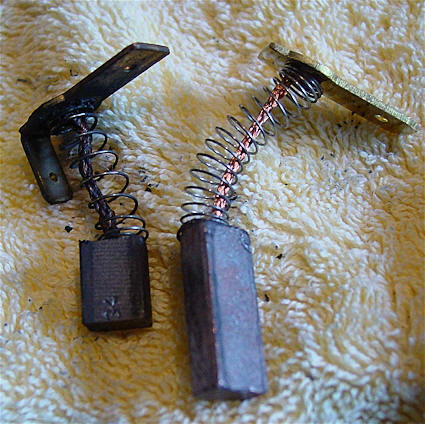
The deceased one opposite was one of four that I removed from a 1 year old
Sunrise F55 motor. (not mine this time - an eBay powerchair) The longer one next to it is a new one obviously. That is what it should look like.
When checked.
Again if anyone especially an "expert" tells you that they don't wear or burn
out they are talking crap. Most PEOPLES don't but some just do. You only have to look at the pile I have here to see
that from an assortment of DIFFERENT powerchairs!
SOME people use (burn) up a set of motor brushes every
year or so. I certainly do, some of my friends do too in every make of powerchair
imaginable. Some (most) people don't seem to do any damage at all and they last forever
and look like brand new years later,
I have regularly checked them on other
peoples wheelchairs and found them to be as good as new after 5 years. I mean as
absolutely as new! But if you are in the minority that does burn them up
its best to know. Knowledge is power and in this case it will save you getting
stranded somewhere.
So if this sounds like you (loony in
powerchair) get someone to check them (its a twenty minute job on
most power wheelchairs) once a year BEFORE its too late and you get stranded
somewhere cold and wet. Better safe than sorry. I have a pile of burned short
ones here... A pretty big pile.
While the brushes are out blow all the carbon
dust out of the motors with an airline. I tipped about an egg cup full of carbon
dust and rust out of the last motor I stripped down. That stuff will damage
bearings and windings as well as increase the wear rate of the motors brushes
which cause the carbon in the first place...
Better safe than sat outside for 4 hours not moving in the winter. Most likely
yours will be fine. That's great and at least you will know. Also be aware
that all the salt that the local authorities throw on our roads can also cause
corrosion and oxidation which can combine with the carbon dust and make the
brushes stick. That also ruins your day. So I check them yearly if only for peace
of mind.
Controllers.
That rectangular box under the seat (usually)
controls the battery current and is also a computer that has all of your
programmed setting stored in it. Frankly I have never
seen one go wrong. People tell me they do, so they must do occasionally but look
elsewhere first for your problem first! Wiring, connections, motors, brakes,
battery terminals, Unless there is signs of severe water ingress or
some other clue. (smell it it should NOT smell of anything! Burning smells would
be bad.) But mostly check for wiring, security and corrosion, or burning.
Pod or Control module.
These CAN give trouble if really wet. The charging sockets can and do burn/melt
and they are truly inadequate (see
here for a fix), the
data cable that connects it to the controller box under the seat can be
disconnected or faulty. But again this is unusual. Most makes have a bunch of
flashing lights or "fault codes" and these can help diagnose a problem. Go to
the manufacturer of your specific control system for these error codes.
 Wheel bearings. Wheel bearings.
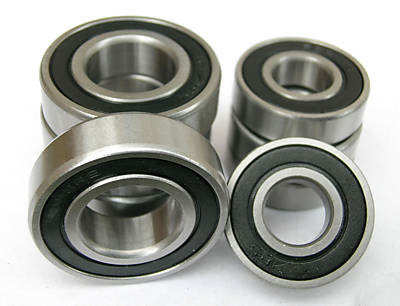
Standard steel
bearings opposite >>
Actually caster wheel bearings. I was sick to death of replacing these. They
don't really belong on this page since they wont actually stop you getting home.
First
they start making a noise and then they start to get worse and in the end the
noise gets embarrassing! They don't
actually fail terminally in most cases, badly enough to leave you stranded, but they are a
big problem to many users. And a pain to keep replacing every few months if you
are one of them!
This applies to both manual and powered wheelchairs obviously
They are steel ball races that use a rubber seal (the black bit in the picture) and are greased internally for
life. They fail because of the salty roads and or just the wet weather. Water
gets inside them because pet hair or human hair my GF has got long blond hair
and its easy to identify and blame! + I have a number 1 (short) so its definitely not me!
gets wrapped around the axle and then it gets pulled into the bearings past the
rubber seal. The hair doesn't do the damage but it then stops the rubber
seal working properly and water gets in. This causes rust... Rust is
not good here. Rust is the cause of the failures as the balls get pitted
and go black and the mix of water and grease escapes.. By the time you get to
look inside after pulling the rubber seal off they are red rusty...

The easy and
cheap solution is to fit these.
Stainless steel Bearings >>
Water ingress doesn't cause
corrosion any longer. I no longer get any failures or rusty bearings!
Stainless steel replacement bearings are cheap at a few pounds each. So why do the manufacturers not fit them?
You tell me! They just don't think, analyse or care most likely. Maybe
they don't know about the problem or what causes it.
Anyway you
can get them from any bearing place or
eBay
pretty cheaply and not really any more expensive than rust
and corrosion prone standard steel ones. I use these everywhere on my
latest powerchairs
If you don't know how to measure or order bearings just take your old one to a
bearing supplier in any town and tell him you need 4 stainless steel
replacements. Bearings come in standard metric and imperial sizes. Don't
buy them from a powerchair or wheelchair manufacturer as they don't make them! Much like they don't make the tyres, batteries, lights, control systems, the
fasteners, all the rubber bungs and plastic plugs, etc etc. Most wheelchair
manufacturers just source all this stuff from the rest of the world and they
only make the basic frame + braketry and the seating stuff that holds it all
together! Much
powerchair and wheelchair stuff can be found cheaper and better elsewhere if you
know where to look.
Bad connections and wiring
Of the half dozen times over 12 years of heavy wheelchair usage and abuse one
of the recurrent things that have stopped my powerchair is wiring or rather the
connectors...
There have been two occasions of the main motor brushes connections actually
burning off or melting the wiring due to bad or high resistance connections.
Once again the biggest culprit here is the mountains of
damned
Salt the local
authorities insist on pouring on our roads for 6 months of the year. It does the
same damage to cars, motorcycles and shoes and wildlife too.
The connections get soaked in covered in crap and they corrode and oxidize.
They then make bad contact and then they burn or just fail to connect and there
you are stranded yet again! If you barely go out in winter or wash it with
clean water when you do every time you come in probably wont have this problem. If you do then its
almost inevitable. Salt and water and wiring don't mix well. I build my own
powerchairs very carefully and use Vaseline on
all connections so that this no longer happens to me but I have rescued several
others (friends) with this problem this year alone.
Fix: Do this BEFORE you break down! Make sure all connections absolutely clean down to bare metal. And are very
tight (use pliers on spade connections and make sure they are really tight). If
you can push them on and off with your fingers easily they are not tight enough!
Coat in petroleum jelly or Vaseline to keep water out.
Po werchair
Fusible Link or Battery main fuse.
Our powerchairs all have a big "fuse" or a fusible link in the battery cables
or attached to the frame somewhere. A few have a "trip" switch. These things are
designed to save us from horrors such as battery explosions or fire caused by a
big short circuit. These fuses are often hard to spot but you do have one.
They can just blow. For no real reason. Its not happened to me yet (trust me
it will!) but I have seen it happen to others. Its more likely to happen on a
powerchair with a big controller, maybe that's reprogrammed for some proper
response. Now you SHOULD keep a spare and know where it goes and how to fit it
so if all else fails you can get someone else to do it while you tell them how!
Do you have one with you at all times? You should and you should have any tools
needed to fit it too. Maybe stored in your battery compartment wrapped in
something like a rubber glove as we don't want any short circuits... One day you
will be pleased you bothered.

Battery fuse on a powerchair bigger |
Battery
Fuse electric wheelchair huge!
See the TINY bulge on the red cable?
The one covered by a bit of heat shrink tube? That's a 230 Amp fuse... In this case
its easier to just order a new battery cable from the manufacturer as its all
one bit. I have a
spare lead in my battery box just in case because you never know! If this fails you
are going absolutely nowhere! Most powerchairs use a replicable fuse in
one of the leads. As below:

This is a 150 amp fuse. That's too small for my powerchair but I found this
unknown power lead from someone's old PowerChair just to show you what to look
for. This is with the rubber covers pulled back so you can see it obviously. It
can be changed with just a screwdriver. You do have a spare and a screwdriver
wrapped in some bubble wrap in your battery box just in case don't you? Well you
should!
Punctures
Well there are all kinds of cures here. Some better than others. Obviously
punctures can be a big problem. Most of this I have covered elsewhere so will
give links.
- Tubeless tyres. Tubeless tyres are way less likely to suffer a puncture.
And when they do they generally do not deflate much as the object (nail?)
stays in. Think about it like
this... Threres no tube to pop like a balloon. The reason your car gets
hardly any punctures is for exactly this reason. Even if the nail
comes out the tube is bonded to the inside of the tyre so cannot expend and
leak. I have converted my
powerchairs over to better stronger and
tubeless tyres for this reason click the link to find out more but its a big
page!
- Solid, Green, foam and foam filled tyres. These are puncture proof
obviously. But I have tried all of them. I removed them within a week
because of both a "soft" and hard to "push" and therefore battery draining
sogginess that somehow also manages to jar my spine and be so uncomfortable
that my back hurt every time I went out... You may find them better but not
for me! In addition they are mostly grey which means that the carbon
is missing from the rubber so they crumble and go yellow fast. I hate grey
tyres which is yet another reason I wont use them on my own
powerchairs
- Tyre Seal -- this stuff is essential! It sits in the tyre waiting for
you to get a puncture. And seals it before you know. I have a page on this
tyre seal here.
- Tyre Weld Aerosols. This is used after you
get a flat tyre...
Batteries
I have on occasion been let down by batteries. NOT because it was gradually
discharged as we can all see and feel that happening. And that would be my own
fault! But by an internal failure. Most likely a connecting strap inside the
battery. These were Haze EV batteries. So I don't recommend them obviously. Other
than that they were good batteries as
shown here.
Rain
Surprisingly almost all modern powerchairs are pretty rain proof. Don't worry
about going out in the rain.
The motors and batteries don't mind water at all. A 24 volt wheelchair motor
will actually perform pretty normally completely submerged in a bucket of water. Rain water
does not conduct enough electricity to have any real effect on the motors.
Although they would suffer corrosion and bearing problems if you tried this
trick very often!
As an aside I once cleaned a 3kw (3000 watts)
electric fan heater by lowering it into a bucket of tap water while it was
running. This scared the crap out of my carer Brian who has seen far
too many movies. He really expected flashes and sparks and bangs etc. Now I understand
Physics. I knew what would likely happen. Very little. I was holding the cable,
and lowered it in slowly. A little steam, and then nothing. Completely submerged
for about 3 mins. Result? A clean heater, a bucket full of dirty dusty but
warmer water
and a puff of steam as it emerged still running. Don't try this at home.
Or if
you do then just don't touch the wet heater or the water! Or blame me... And here in the UK we have
240 volts AC. Non of your namby pamby 120v like the USA. Our 240v is actually
330 volts peak to peak since its a sine wave "average" voltage. So your 24v motors really don't
care about the rain electrically. Other than the corrosion that it will cause.
Batteries also can be submerged and there will be no electrical shorting or
anything. But if the top of them gets submerged they could draw in some water
under certain circumstances which would dilute the acid / gel and the impurities would damage them long
term. No short circuits of fires though. So you wont break down. But don't actually try to drive under water... But rain
really isn't an issue. Not even
huge puddles.
The Control Pod, and the black box under the seat CAN be damaged by water or
at least become non functional until dried out. Rain wont do it unless you sit
outside for the day in a hurricane. The pod is
sealed quite well from the weather but don't try pressure washing the pod!
I have made one wet enough to give malfunction warning lights. And it wouldn't
turn on. But I really did try hard!
The computerised box under the seat should be pretty safe unless the water you are driving
through can reach it! You would have noticed 18 inches of water by then though.
So rain wont hurt this either. At least if the box is well out of the way as it
should be in a properly designed powerchair (like my own!)
That is about it. That's all that really seems to go wrong, at least as far
as getting home is concerned. Many smaller issues can happen but nothing
that traps you away from home. Although no doubt someone else will have a
horror story about some other part that has failed them!
If so email me.
But frankly there isn't much to a powerchair. They are really very simple things.
With
normal use and a little cleaning now and again they should be extremely reliable
for the vast majority of AVERAGE users over many years of use.
Detailed PowerChair Only Menu |


